Modern vehicles contain dozens of cameras, radar sensors, LiDAR units, and infotainment systems — all requiring reliable, high-frequency signal connections. Two connector families dominate this space: FAKRA for RF (radio frequency) signals, and HSD (High-Speed Data) for differential data signals. Understanding when to use each, and the differences between them, is essential for automotive system designers and harness engineers.
What Is FAKRA?
FAKRA stands for Fachkreis Automobil (German for "Automotive Technical Committee"). The FAKRA connector system is a standardized coaxial connector family developed specifically for automotive RF applications. It is defined by the DIN 72594 standard and is widely used across European and global automotive OEMs.
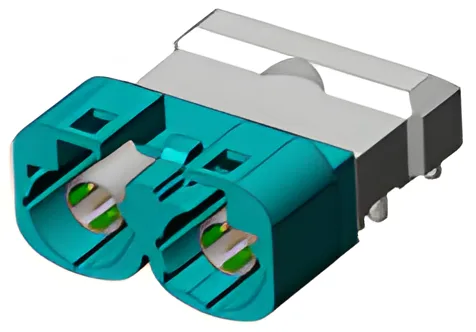
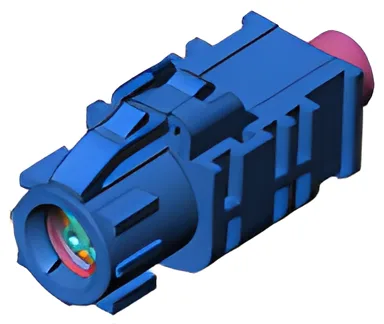
FAKRA connectors are coaxial — they carry a single RF signal with a center conductor surrounded by a dielectric and outer shield. This construction provides the impedance control and shielding needed for RF signals.
FAKRA Color Coding
FAKRA connectors use a color-coded keying system to prevent mismating between different signal types. Each color corresponds to a specific application:
| Color | Application |
|---|---|
| Blue | GPS antenna |
| Red | Cellular (GSM/LTE) |
| Yellow | Satellite radio (SiriusXM, DAB) |
| Green | Diversity antenna |
| White | SDARS (Satellite Digital Audio Radio) |
| Black | General purpose / video |
| Violet | Backup camera / CVBS video |
| Brown | Telematics |
| Orange | SDARS / XM |
| Beige | Antenna diversity |
The keying prevents, for example, a GPS antenna cable from being accidentally connected to a cellular antenna port. This is critical in automotive assembly where hundreds of connectors are installed on a production line.
FAKRA Specifications
- Impedance: 50Ω (standard) or 75Ω (video applications)
- Frequency range: DC to 6 GHz (depending on variant)
- Mating cycles: 30 minimum (automotive grade)
- Operating temperature: -40°C to +105°C
- Locking: Snap-lock with audible click
- IP rating: IP6K9K (sealed variants)
FAKRA Applications
FAKRA connectors are used for:
- GPS/GNSS antennas: Connecting roof-mounted GPS antennas to navigation modules
- Cellular antennas: 4G/5G antenna connections for telematics and connected car systems
- Satellite radio: SiriusXM and DAB antenna connections
- Backup cameras: CVBS video signal from rear cameras to head units (75Ω variant)
- Radar: Some short-range radar sensors use FAKRA for RF connections
- V2X (Vehicle-to-Everything): DSRC and C-V2X antenna connections
What Is HSD?
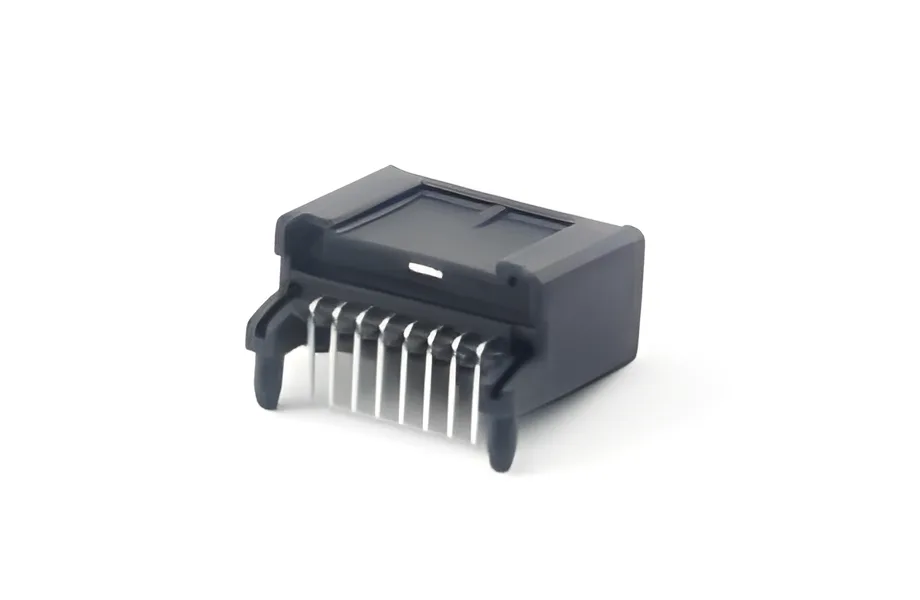
HSD (High-Speed Data) is a differential signal connector system developed by Rosenberger for automotive high-speed data applications. Unlike FAKRA's coaxial construction, HSD uses differential pairs — two conductors carrying equal and opposite signals — which provides excellent noise immunity and supports much higher data rates.
HSD connectors are defined by the USCAR-2 standard and are used by major automotive OEMs including BMW, Mercedes-Benz, Audi, and Volkswagen.
HSD Variants
HSD 4+2: The most common variant. Contains two differential pairs (4 signal pins) plus 2 power/ground pins. Supports LVDS (Low-Voltage Differential Signaling) and other differential protocols.
HSD 2+2: Two signal pins plus 2 power/ground pins. Used for single differential pair applications.
Mini HSD: A smaller form factor HSD connector for space-constrained applications.
HSD Specifications
- Signal type: Differential (LVDS, APIX, FPD-Link, GMSL)
- Data rate: Up to 6 Gbps per pair (depending on protocol)
- Operating temperature: -40°C to +125°C
- Mating cycles: 30 minimum
- IP rating: IP6K9K (sealed)
- Impedance: 100Ω differential
HSD Applications
HSD connectors are used for:
- Surround-view cameras: High-resolution camera data from multiple cameras to the central processing unit
- ADAS cameras: Forward-facing cameras for lane departure warning, automatic emergency braking
- Rear-view cameras: High-definition backup camera video (replacing FAKRA CVBS in newer systems)
- Display connections: Video data from head units to instrument clusters and center displays
- LiDAR: Point cloud data from LiDAR sensors to ADAS processors
- Radar: High-resolution radar data in newer 4D imaging radar systems
FAKRA vs HSD: Key Differences
| Parameter | FAKRA | HSD |
|---|---|---|
| Signal Type | RF (coaxial, single-ended) | High-speed differential |
| Construction | Coaxial | Multi-pin differential |
| Impedance | 50Ω or 75Ω | 100Ω differential |
| Frequency/Data Rate | DC to 6 GHz | Up to 6 Gbps per pair |
| Protocols | RF (GPS, cellular, CVBS) | LVDS, APIX, FPD-Link, GMSL |
| Color Coding | Yes (application-specific) | No |
| Pin Count | 1 signal + shield | 4+2 or 2+2 |
| Primary Use | Antenna, RF, legacy video | Camera, display, ADAS data |
| Standard | DIN 72594 | USCAR-2 |
The fundamental difference is the signal type. FAKRA is for RF signals — antenna connections, radar RF, and legacy analog video (CVBS). HSD is for high-speed digital data — camera video streams, display data, and sensor data using differential signaling protocols like LVDS.
In a modern vehicle, you will find both:
- FAKRA on the GPS antenna cable, cellular antenna, and satellite radio antenna
- HSD on the camera cables connecting surround-view cameras to the ADAS processor
Mini FAKRA
As vehicles become more connected and space constraints tighten, Mini FAKRA has emerged as a smaller alternative to standard FAKRA. Mini FAKRA connectors are approximately 40% smaller than standard FAKRA while maintaining the same color-coded keying system and RF performance.
Mini FAKRA is increasingly specified for:
- Compact telematics control units (TCUs)
- Antenna modules in tight spaces
- Multi-antenna systems where multiple FAKRA connectors must fit in a small area
The Mini FAKRA standard is defined in ISO 20860.
Choosing Between FAKRA and HSD
The choice between FAKRA and HSD is determined by the signal type, not by preference:
Use FAKRA when:
- Connecting antennas (GPS, cellular, satellite, V2X)
- Carrying RF signals (radar RF, DSRC)
- Transmitting analog video (CVBS backup camera in legacy systems)
- The application requires color-coded keying to prevent mismating
Use HSD when:
- Transmitting high-definition camera video (LVDS, APIX, FPD-Link, GMSL)
- Connecting displays to head units or instrument clusters
- Carrying high-speed sensor data (LiDAR, 4D radar)
- The application requires differential signaling for noise immunity
In many modern vehicles, a single camera system uses both: FAKRA for the RF connection to a radar sensor, and HSD for the video data from the camera.
Automotive Connector Quality Requirements
Both FAKRA and HSD connectors must meet stringent automotive quality requirements:
Temperature cycling: -40°C to +125°C (or +150°C for under-hood applications) Vibration resistance: Per ISO 16750-3 or equivalent Humidity resistance: Per ISO 16750-4 Chemical resistance: Resistance to automotive fluids (oil, fuel, brake fluid, coolant) Mating force: Defined maximum insertion and extraction forces for assembly line use Contact resistance: Low and stable over the connector's service life
CZT's automotive connector range includes FAKRA and HSD connectors meeting automotive-grade quality standards, with options for sealed and unsealed configurations across all standard color codes and pin configurations.
Summary
FAKRA and HSD serve complementary roles in automotive wiring:
- FAKRA = RF coaxial connector for antennas and RF signals, color-coded by application
- HSD = High-speed differential connector for camera video, display data, and ADAS sensor data
Both are essential in modern vehicles, and both must meet the demanding temperature, vibration, and chemical resistance requirements of the automotive environment. When specifying connectors for a new automotive design, identify the signal type first — RF or high-speed differential — and select the appropriate connector family accordingly.
For sourcing FAKRA, HSD, and other automotive connectors, CZT offers a comprehensive range of automotive connectors with full automotive-grade qualification.


