Choose a reduced-pin USB-C receptacle only after confirming that its actual terminal arrangement supports the product circuit. A six-pin description does not establish data support, power negotiation behavior or compliance. The drawing and system schematic must answer those questions together.
For candidates in the USB-C connector family, obtain the full terminal definition and relevant application information. USB-IF's cable and connector resources provide the applicable specification and functional-test references; a catalog pin count is not a substitute for those requirements.

Figure 1. CZT 10317106L001 Type-C example provides an identified construction for reviewing the device circuit and mating requirements before selection. CZT source · Original image.
Write the product's functions first
State whether the port is intended for power input, power output, communication or a combination. Include service and manufacturing uses that may be easy to overlook. A maintenance tool that needs data can change the connector choice even if the everyday user only connects power.
List the intended sources, cables and operating states. Distinguish the power condition requested by the product from the capability advertised by an external supply. Selection should be based on an explicitly reviewed system, not on the largest power number found in related marketing material.
Map every available terminal
Create a schematic-to-terminal table from the exact drawing. Identify power, return, configuration and any other connections present. Preserve the manufacturer's view convention in the design record so the PCB layout does not reverse the interpretation.
| Review question | Evidence to obtain |
|---|---|
| Which terminals are physically present? | Controlled connector drawing |
| Which functions does the circuit require? | Approved schematic and use cases |
| How is attachment detected? | Relevant controller or circuit documentation |
| Does orientation change behavior? | Two-orientation system evaluation |
Do not assume that connections missing from the connector are internally joined or recreated elsewhere. Any internal connection should be explicitly documented for the selected model.
Examine realistic connection combinations
Use identified sources and cables that represent the intended application. Observe attachment behavior and the resulting operating condition in both orientations. Include startup, disconnect and reconnect behavior where those actions matter to the equipment.
For a hypothetical rechargeable instrument, a prototype might appear successful with one legacy cable but fail to start from another intended supply. The appropriate response is to investigate the system's configuration and power path. Adding an arbitrary connection merely to reproduce the first demonstration does not establish a valid design.
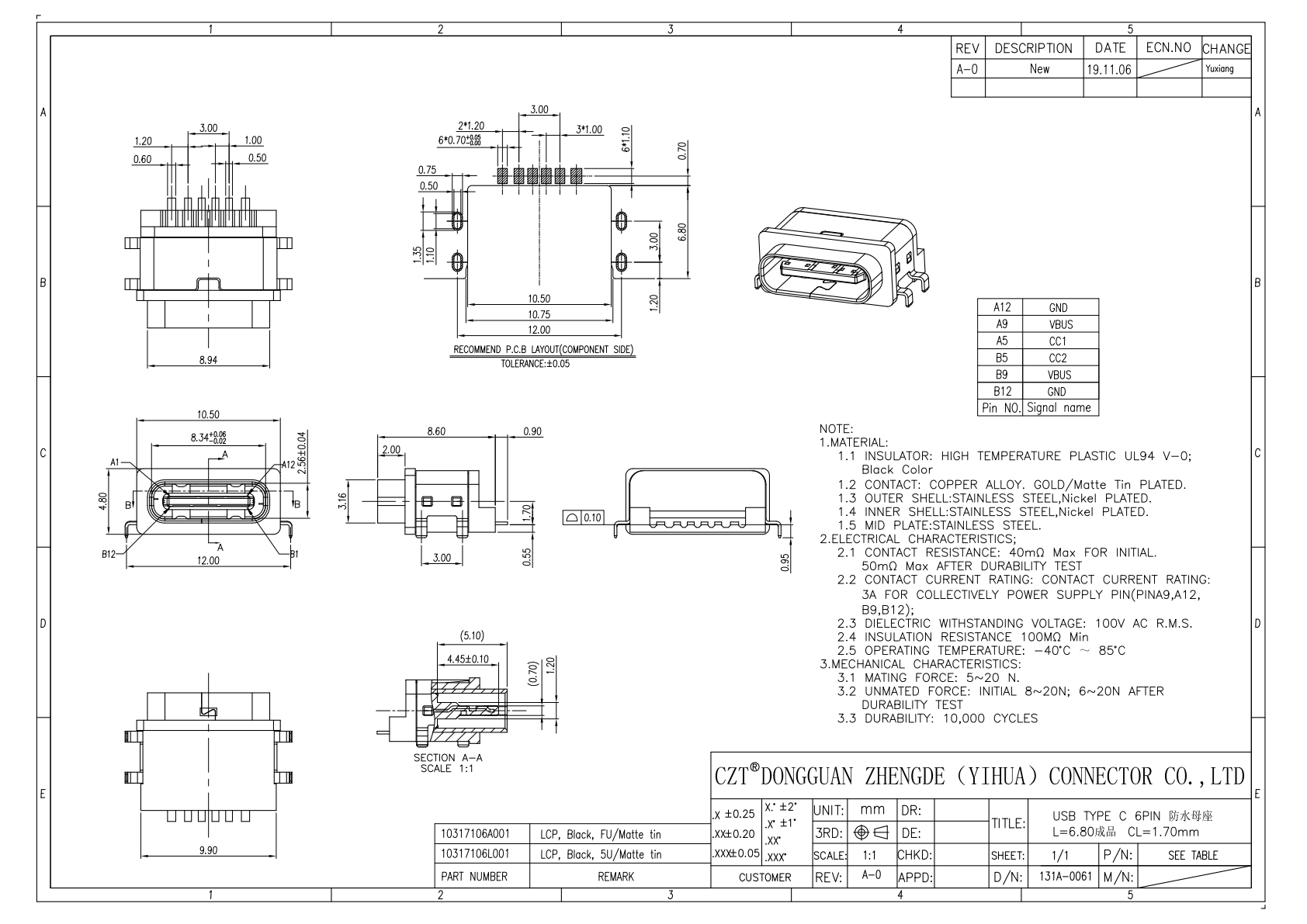
Figure 2. Official drawing for the same Type-C example provides the pin and mechanical reference to compare with the actual charging-circuit requirement. CZT source · Original PDF, page 1.
Decide with a recorded boundary
If the product requires functions the reduced-pin device does not provide, select another connector architecture rather than leaving the requirement undocumented. If the reduced arrangement is suitable, record why, with the exact circuit and supported connection combinations.
Keep mechanical requirements in the same review. A suitable electrical arrangement still needs the correct board height, attachment geometry and enclosure access. Approve the full connector model and board implementation after testing, and revisit that decision when the controller, external connection requirements or receptacle drawing changes.
Connect this review to CZT product information
Start with the relevant CZT product family and provide the original interface reference or controlled drawing. Ask which configurations and supporting documents are available for the task described here. Confirm the mating arrangement, required features and project conditions before choosing an orderable part.
Browse the relevant product family · View catalog resources
Discuss a drawing, sample or quotation
Share the part or family reference, current drawing revision, operating conditions and quantities. Include the specific checks described in this article so the inquiry identifies both the component and the evidence needed for your decision. Confirm sample availability and the proposed scope with the supplier.
Request a technical review or quotation
For broader context, read the related selection guide.