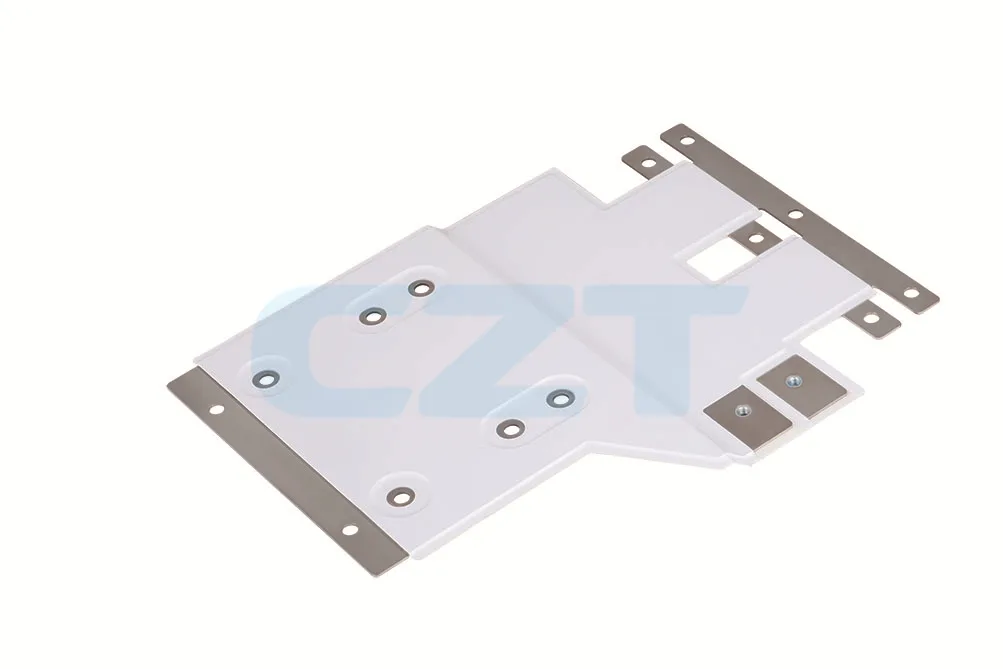
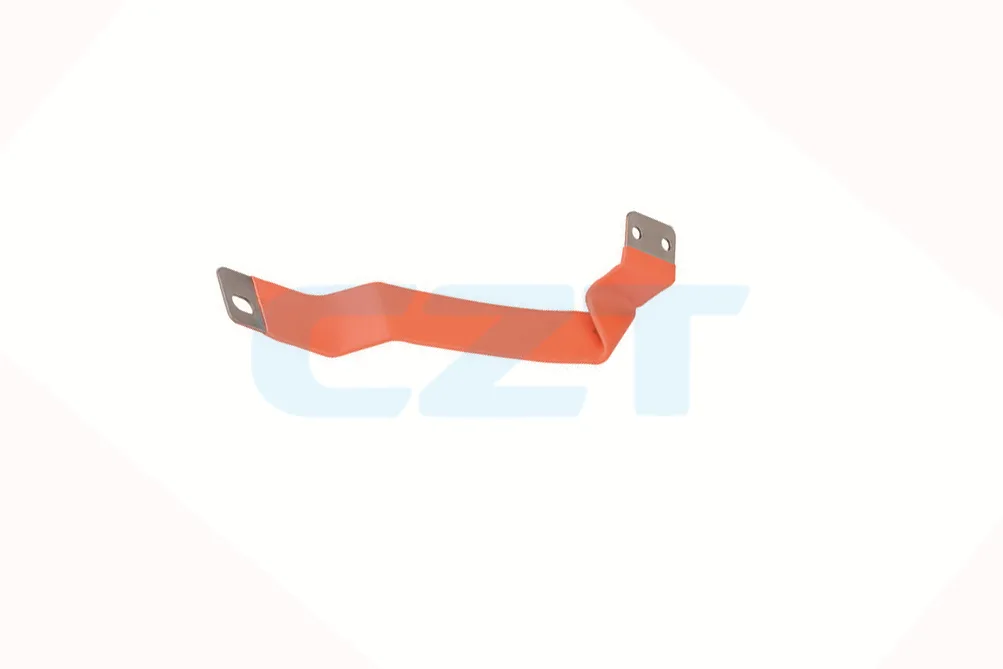
An ESS busbar needs an intentional way to accommodate dimensional change between its electrical terminals and supporting structure. Review thermal movement together with installation tolerances and constraints. Simply adding a long slot at one end does not establish that the finished assembly can move without loading a terminal, disturbing a contact or compromising insulation.

Figure 1. CZT flexible connection example provides geometry for discussing intentional movement and restraint between terminals, without establishing an allowable displacement. CZT source · Original image.
Identify what is fixed and what can move
Mark the terminal locations, support points and assembly datums on an installed drawing. For each point, state which directions are constrained. Include the cabinet and connected equipment because their movement may differ from that of the busbar.
Use the actual material data and operating-temperature range to estimate movement. Distinguish temperature during assembly from temperature during operation. An installation made near one end of the temperature range may have less travel available in one direction than a centered CAD illustration suggests.
Combine movement with tolerance
Evaluate the full position range of terminals, supports and the busbar itself. Do not spend the same allowance twice by assuming that an elongated hole independently accommodates both maximum assembly error and maximum thermal travel.
A flexible section may be a candidate where a rigid constraint would transfer excessive load, but its suitability depends on direction, geometry and verified movement capability. The Copper Alliance busbar guide identifies longitudinal expansion as a joint-design consideration. It does not assign a universal movement allowance to a custom assembly.
Use a constraint review table
| Location | Required review |
|---|---|
| Primary datum | Which position establishes assembly alignment? |
| Electrical joint | Is movement intended here or prohibited? |
| Secondary support | Which directions can it accommodate? |
| Flexible section | What displacement, rotation and restraint are expected? |
| Insulation or cover | Does clearance remain adequate across the travel range? |
Review the extremes as assembled configurations. A part can fit at both nominal endpoints yet encounter interference along the path between them.

Figure 2. CZT rigid server busbar has separated end interfaces. Include cabinet constraints and terminal-position variation when reviewing thermal expansion. CZT source · Original image.
Verify the installed behavior
Build the relevant tolerance and temperature cases, or justify another representative validation approach. Observe terminal loading, support movement, contact condition and insulation clearances. Record the actual starting position and constraints, not only the applied temperature.
For a hypothetical cabinet, a terminal-position offset may consume most of a proposed floating support's travel before operation begins. The right correction may be a datum change or a different support arrangement rather than a larger conductor.
Check the assembly sequence as well as the final position. Fastening every support before aligning the terminals can introduce a constraint different from the one assumed in the model. State the intended sequence and verify it with a representative trial build.
CZT's busbar and energy-storage family includes a catalog reference for an Energy Storage Flexible Busbar. Use it to begin a construction-specific discussion, not as proof of a displacement or fatigue rating. Release the design with a clear assembly position, permitted movement directions and evidence for the completed installed arrangement.
Connect this review to CZT product information
Catalog references to discuss are listed below. Use the identifiers to request the current drawing and confirm the configuration required by your application.
| Catalog reference | Product information | Drawing record | Reference inquiry |
|---|---|---|---|
| Energy-storage laminated busbar catalog record | Energy-storage laminated busbar catalog record | Request the current drawing | Ask about this reference |
| Energy-storage flexible-connection catalog record | Energy-storage flexible-connection catalog record | Request the current drawing | Ask about this reference |
These entries identify catalog families. Their listing does not establish a numerical rating, finished-part tolerance or test approval; obtain that evidence for the requested revision.
Browse the relevant product family · View catalog resources
Discuss a drawing, sample or quotation
Share the part or family reference, current drawing revision, operating conditions and quantities. Include the specific checks described in this article so the inquiry identifies both the component and the evidence needed for your decision. Confirm sample availability and the proposed scope with the supplier.
Request a technical review or quotation
For broader context, read the related selection guide.