Busbars are the backbone of power distribution in battery packs, energy storage systems, EV powertrains, and industrial switchgear. The choice between flexible busbars and rigid busbars affects thermal performance, mechanical reliability, assembly complexity, and cost. Getting this decision right at the design stage prevents expensive redesigns later.
This guide covers the key differences between flexible and rigid busbars, the scenarios where each excels, and the design parameters that drive the selection.
What Is a Rigid Busbar?
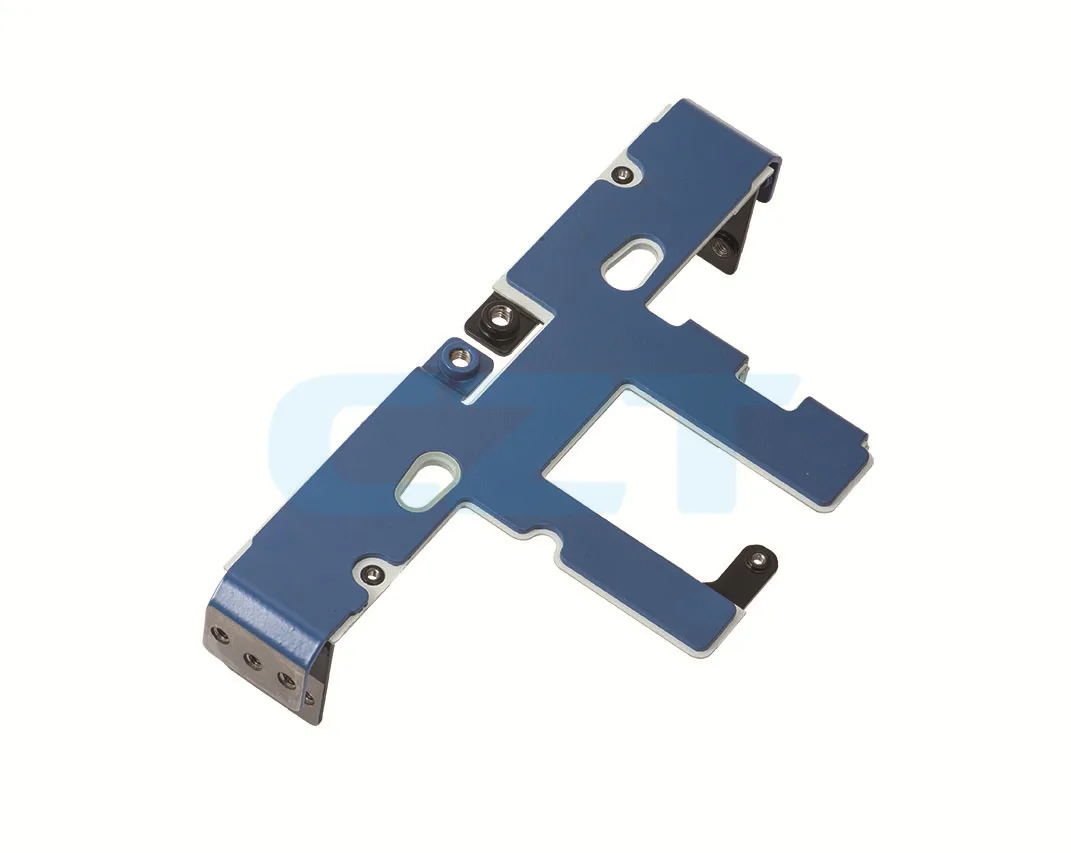
A rigid busbar is a solid conductor — typically a flat bar or shaped profile of copper or aluminum — that carries current between two fixed points. Rigid busbars are machined, bent, or stamped to the required shape and are bolted or welded in place.
Rigid busbars are the traditional choice for:
- Switchgear and distribution panels
- Industrial motor drives
- UPS systems
- Fixed power distribution in data centers
- High-current connections where both endpoints are mechanically stable
Rigid Busbar Materials
Copper (C11000 or C10100): The standard material for high-performance busbars. Copper offers excellent electrical conductivity (100% IACS for pure copper), good thermal conductivity, and is easy to solder and braze. Electrolytic tough pitch copper (C11000) is the most common grade; oxygen-free copper (C10100) is used where hydrogen embrittlement is a concern.
Aluminum (1100 or 6101 series): Lower conductivity than copper (~61% IACS) but significantly lighter and cheaper. Aluminum busbars are used where weight and cost are priorities and the larger cross-section required for equivalent current capacity is acceptable. Common in solar inverters, large UPS systems, and utility-scale energy storage.
Tin-plated copper: Tin plating improves corrosion resistance and solderability. Standard for busbars in humid or corrosive environments.
Silver-plated copper: Used in high-performance applications where contact resistance must be minimized. More expensive than tin plating.
What Is a Flexible Busbar?
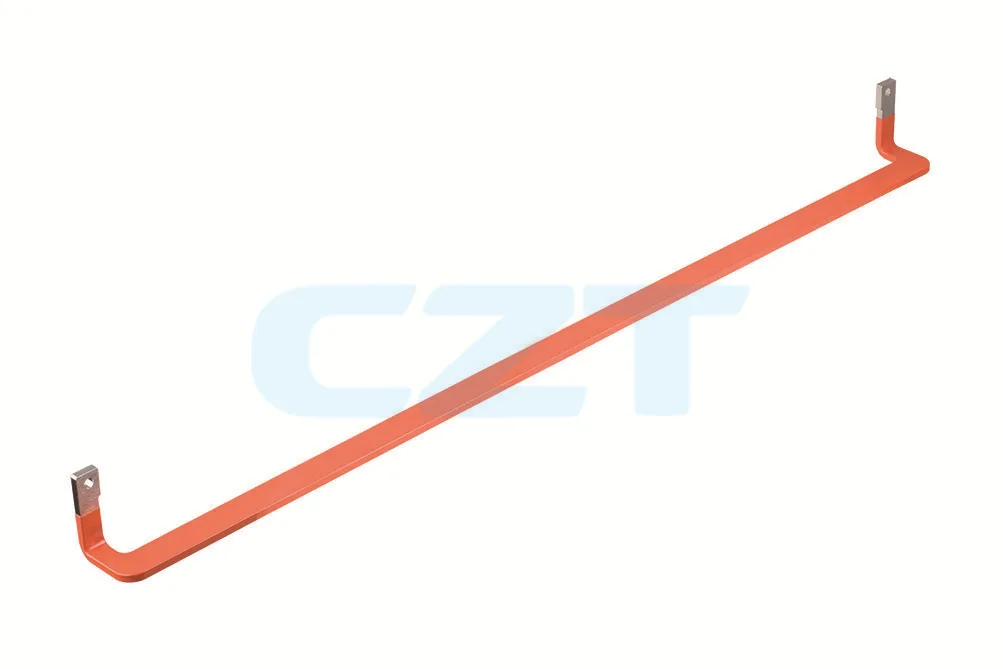
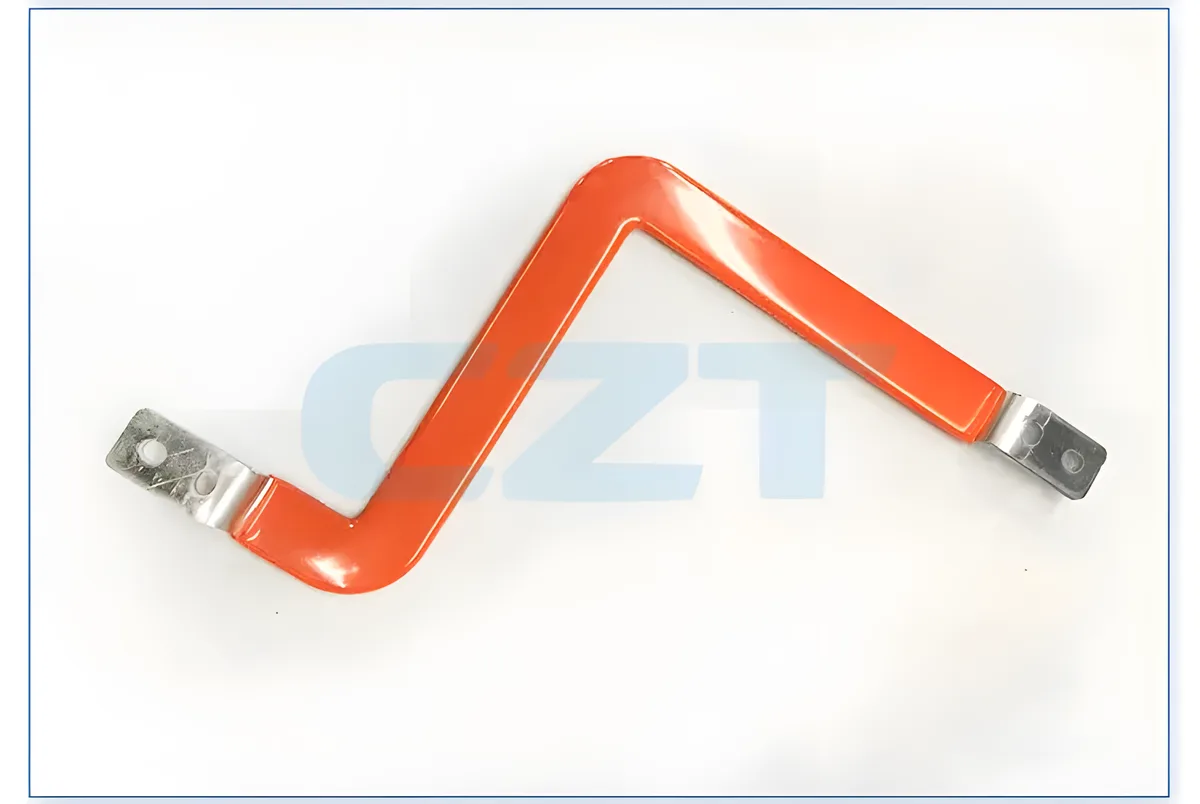
A flexible busbar (also called a laminated busbar or flexible copper braid) consists of multiple thin layers of conductor material — either thin copper foil laminations or woven copper braid — that can flex and bend while still carrying high currents.
There are two main types:
Laminated flexible busbars: Multiple thin copper foil layers (typically 0.1–0.5mm thick) stacked and bonded together. The thin layers allow the assembly to flex while the total cross-section provides the required current capacity. Laminated busbars are used in battery packs, EV powertrains, and energy storage systems.
Braided flexible busbars: Woven copper wire braid, similar in construction to a coaxial cable shield but much larger. Braided busbars are used for grounding straps, vibration isolation, and connections between components that move relative to each other.
Flexible Busbar Materials
Flexible busbars are almost always copper, because the repeated flexing would cause aluminum to work-harden and crack. Copper's superior fatigue resistance makes it the only practical choice for flexible applications.
Surface finishes include:
- Bare copper: Lowest cost, requires protection from oxidation
- Tin-plated: Standard for most applications, good corrosion resistance
- Nickel-plated: Higher temperature resistance, used in high-temperature environments
- Silver-plated: Lowest contact resistance, used in high-performance battery applications
Flexible vs Rigid Busbar: Key Differences
| Parameter | Rigid Busbar | Flexible Busbar |
|---|---|---|
| Mechanical flexibility | None | High (laminated) or moderate (braid) |
| Vibration absorption | Poor | Excellent |
| Thermal expansion accommodation | Limited | Good |
| Current density | High | Moderate (more material needed) |
| Weight | Lower (for same current) | Higher (more copper layers) |
| Cost | Lower | Higher |
| Assembly complexity | Moderate | Lower (no precise alignment needed) |
| Inductance | Low (flat bar) | Higher (laminated) |
| EMI shielding | None | Some (laminated with insulation) |
| Typical applications | Switchgear, fixed installations | Battery packs, EV, ESS |
When to Use Flexible Busbars
Battery Pack Interconnects
Flexible busbars are the dominant choice for connecting battery cells and modules in EV battery packs and stationary energy storage systems. The reasons are compelling:
Vibration tolerance: Battery packs in EVs experience continuous vibration from road surfaces. Rigid busbars transmit this vibration directly to the cell terminals, which can cause fatigue cracking at the connection point over time. Flexible busbars absorb vibration, protecting the cell terminals.
Thermal expansion: Battery cells expand and contract with temperature and state of charge. A rigid busbar connecting two cells that expand at different rates will either bend (if it can) or stress the cell terminals. Flexible busbars accommodate this movement without stress.
Manufacturing tolerance: Flexible busbars compensate for dimensional variation in cell positioning. In a large battery pack with hundreds of cells, small positional errors accumulate. Flexible busbars bridge these gaps without requiring precise cell alignment.
Assembly: Flexible busbars can be placed and bolted without the precise fixturing required for rigid busbars. This simplifies automated assembly.
Energy Storage Systems (ESS)
Large-scale battery energy storage systems (BESS) use flexible busbars for module-to-module connections within battery racks. The same vibration and thermal expansion arguments apply, and the flexible busbars also simplify field installation and maintenance.
Connections Between Moving Components
Any application where two connected components move relative to each other requires flexible busbars. Examples:
- Connections between a fixed inverter and a sliding battery drawer
- Connections across a vibration-isolating mount
- Connections to components on shock-absorbing mounts
High-Frequency Power Electronics
In power converters and inverters, laminated busbars with integrated insulation layers can be designed to minimize stray inductance. The close spacing of positive and negative conductors in a laminated busbar causes their magnetic fields to partially cancel, reducing loop inductance and the voltage spikes caused by fast-switching transistors (IGBTs, SiC MOSFETs).
When to Use Rigid Busbars
Fixed Power Distribution
In applications where both connection points are mechanically fixed and there is no relative movement, rigid busbars are simpler and more cost-effective. Switchgear, distribution panels, and motor control centers use rigid busbars because the connections are permanent and the equipment is designed to accommodate thermal expansion through expansion joints or flexible sections at specific points.
High Current Density Requirements
For a given cross-sectional area, a solid rigid busbar carries more current than a laminated flexible busbar of the same dimensions. The air gaps between laminations in a flexible busbar reduce the effective conductor cross-section. When current density is the primary constraint and flexibility is not needed, rigid busbars are more efficient.
Cost-Sensitive Applications
Rigid busbars are cheaper to manufacture than laminated flexible busbars. For high-volume, cost-sensitive applications where flexibility is not required, rigid busbars are the economical choice.
Low-Inductance Requirements
Flat rigid busbars have lower inductance than laminated flexible busbars of equivalent dimensions. For applications where minimizing inductance is critical (high-frequency switching, EMC compliance), rigid busbars may be preferred — though laminated busbars with close conductor spacing can achieve very low inductance as well.
Current Rating and Sizing
Busbar current rating depends on:
- Cross-sectional area: More copper = more current capacity
- Temperature rise: Typically rated for 30°C or 50°C rise above ambient
- Conductor material: Copper vs aluminum
- Surface finish: Affects emissivity and heat dissipation
- Mounting: Enclosed vs open air affects cooling
A rough rule of thumb for copper busbars in open air:
- 1 mm² of copper cross-section ≈ 1–1.5A (depending on temperature rise allowance)
For a 500A busbar with 30°C temperature rise: approximately 400–500 mm² of copper cross-section required.
For flexible laminated busbars, the effective cross-section is reduced by the fill factor (ratio of conductor to total cross-section). A laminated busbar with 80% fill factor requires 25% more total cross-section than a solid busbar for the same current rating.
CZT's busbar and energy storage connector range includes both rigid copper busbars and laminated flexible busbars for battery pack, ESS, and power distribution applications, with custom sizing and surface finish options.
Design Checklist
When selecting between flexible and rigid busbars, work through these questions:
- Is there relative movement between the connection points? → Flexible
- Is vibration present? → Flexible
- Is thermal expansion significant? → Flexible (or rigid with expansion joints)
- Is the installation fixed and permanent? → Rigid may be sufficient
- Is cost the primary constraint? → Rigid
- Is weight critical? → Rigid (or aluminum)
- Is low inductance required? → Laminated flexible (close-spaced) or flat rigid
- Is the application a battery pack or ESS? → Almost always flexible
Summary
Flexible busbars are the right choice for battery packs, EV powertrains, and energy storage systems where vibration, thermal expansion, and manufacturing tolerances make rigid connections impractical. Rigid busbars remain the standard for fixed power distribution in switchgear, panels, and industrial equipment where simplicity and cost efficiency matter more than flexibility.
In many systems, both types are used: rigid busbars for the main distribution runs, and flexible busbars at the connection points where movement or vibration must be accommodated.
CZT manufactures laminated flexible busbars and rigid copper busbars for energy storage, EV, and industrial applications. Browse our busbar and energy storage product range for specifications and custom options.