Project Snapshot
Detail Value Client EPC Contractor, Southeast Asia Industry Utility-Scale Solar Products Supplied MC4 connectors, branch connectors, PV cable assemblies Scale 50MW ground-mount installation Result 200,000+ connections, zero field failures in 18 months
When an experienced EPC contractor needed a reliable, cost-effective MC4 connector supplier for one of the largest ground-mount solar farms in Southeast Asia, they turned to CZT. This case study details how our TUV-certified MC4 connectors and pre-assembled cable harnesses helped deliver a 50MW project ahead of schedule, under budget, and with a perfect field reliability record.
Project Overview
The project site is located in a coastal province in the Philippines, where annual solar irradiance exceeds 1,600 kWh/m². The 50MW ground-mount solar farm spans approximately 65 hectares of flat terrain and feeds power into the regional grid through a dedicated substation.
The system architecture uses over 120,000 monocrystalline PERC modules rated at 550W each, arranged in fixed-tilt racking structures. String inverters convert DC power to AC across more than 3,000 individual string circuits. Every one of those circuits depends on MC4 connections to carry current safely from panel to panel and from string to inverter.
The design life requirement was 25 years, matching the performance warranty of the solar modules. Every connector on site must withstand a quarter-century of tropical heat, UV radiation, salt-laden humidity, and seasonal typhoon conditions without degradation.
The Challenge
Utility-scale solar projects present connector challenges that residential and commercial installations simply do not. The numbers alone tell the story: this 50MW farm required more than 200,000 individual MC4 connections across the entire array.
At that scale, even a 0.1% failure rate means 200 faulty connections — each one a potential arc fault, fire risk, or source of compounding energy loss.
Beyond volume, the project team faced several specific challenges:
-
Extreme UV and humidity. The tropical coastal climate delivers intense UV radiation year-round, combined with relative humidity regularly exceeding 85%. Standard polymer housings can become brittle and crack under these conditions within a few years.
-
Tight installation window. The EPC contractor had a 12-week window to complete all electrical connections. Delays would push commissioning past the contractual deadline and trigger penalty clauses.
-
Cross-brand compatibility. The project used solar modules from two different manufacturers, each with slightly different junction box configurations. All connectors needed to mate reliably with both panel brands without introducing contact resistance issues.
-
Long-term traceability. The project owner required full batch traceability for every connector installed, enabling targeted inspection or replacement if any quality issue surfaced years later.
Requirements
The EPC contractor's procurement specification was detailed and non-negotiable. Every MC4 connector on the project had to meet the following criteria:
- TUV certification to IEC 62852, the international standard for connectors used in photovoltaic systems
- Rated voltage: 1500V DC, matching the system's maximum string voltage
- Ingress protection: IP68, ensuring complete dust-tightness and protection against prolonged immersion
- Current rating: 30A minimum continuous, with headroom above the module's maximum series fuse rating
- UV-resistant housing: PPO or equivalent engineering polymer rated for 25+ years of outdoor UV exposure
- Cross-brand compatibility: Verified mechanical and electrical compatibility with junction boxes from both module suppliers
- Batch traceability: Unique lot codes traceable to raw material, production date, and test records
The contractor had previously used a well-known European connector brand but rising costs and extended lead times prompted them to evaluate alternatives.
CZT's Solution
CZT proposed a comprehensive connector package tailored to the project's specific requirements. Our renewable energy solutions team worked directly with the EPC contractor's engineering department to validate every detail before production began.
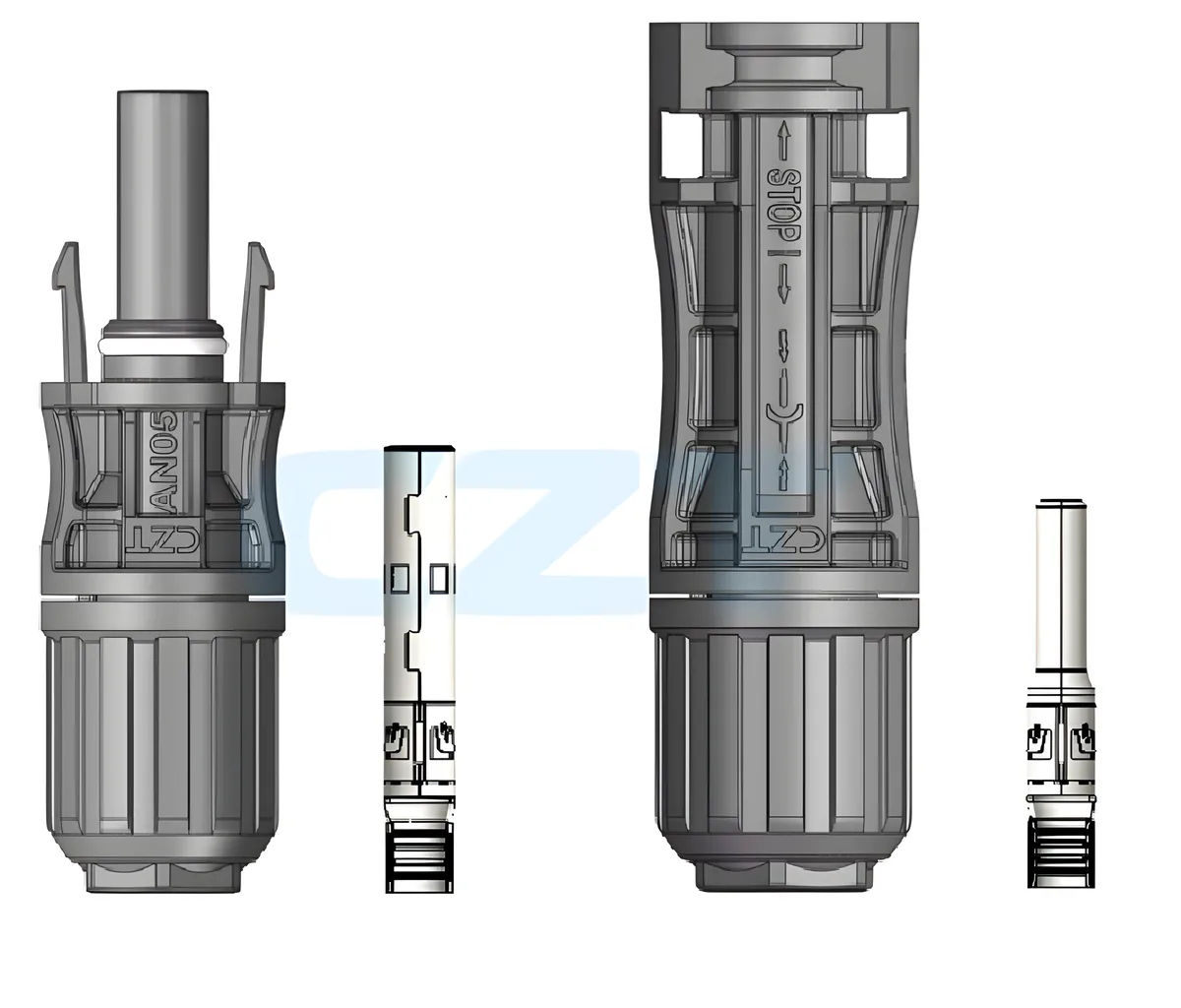
TUV-Certified MC4-Compatible Connectors. Our MC4-compatible connectors carry full TUV certification to IEC 62852. The contact pins and sockets are manufactured from tin-plated copper alloy, delivering low contact resistance and excellent long-term conductivity. The housing uses UV-stabilized PPO rated for continuous outdoor exposure in tropical climates.
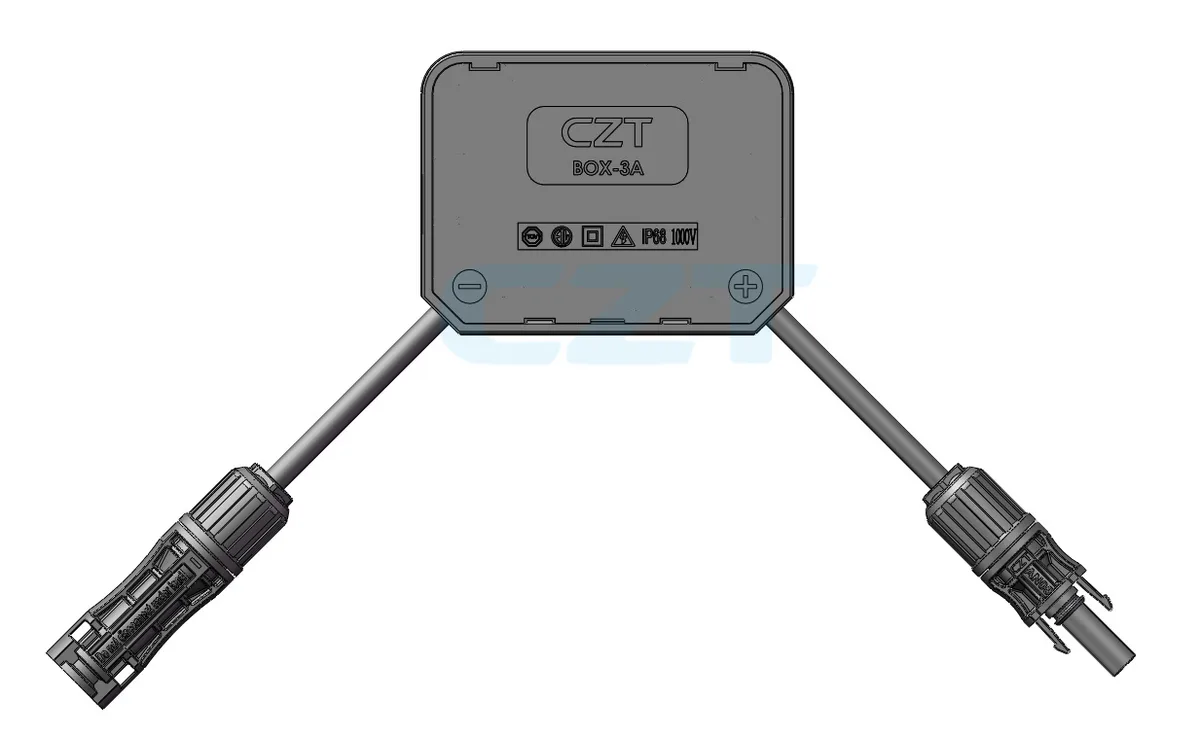
Custom Branch Connectors. The project's string architecture required both 3-to-1 and 4-to-1 branch connectors to consolidate parallel strings before the inverter input. CZT manufactured these to the same TUV-certified standard, with integrated sealing and strain relief on every branch leg.
Pre-Assembled Cable Harnesses. To help the contractor meet the aggressive installation timeline, CZT supplied a significant portion of the connections as pre-assembled cable harnesses. Each harness arrived on site with connectors already crimped, tested, and labeled. This eliminated field crimping for roughly 40% of all connections, dramatically reducing installation labor and the risk of improper termination.
On-Site Technical Support. CZT dispatched two field engineers to the project site during the first two weeks of electrical installation. They trained the contractor's installation crews on proper crimping technique, torque specifications, and visual inspection criteria. They also performed random audits of completed connections to verify workmanship.
For a deeper technical overview of MC4 connector specifications and installation best practices, see our MC4 Connector Guide.
Quality Assurance
Every connector shipped to this project passed through CZT's multi-stage quality assurance process. We do not rely on sampling alone. For utility-scale projects, we apply 100% testing on critical parameters.
100% Electrical Testing. Every assembled connector pair was tested for contact resistance, with units exceeding 0.5 milliohms rejected. This ensures minimal resistive heating across the 25-year service life.
Pull-Force Testing. Crimped connections were tested to verify mechanical retention. Each connection must withstand a minimum pull force of 50N without displacement, confirming that the crimp joint will not loosen under thermal cycling or mechanical vibration.
IP68 Verification. Samples from every production batch underwent immersion testing at 1 meter depth for 24 hours, followed by insulation resistance measurement. All units must maintain insulation resistance above 100 megaohms after immersion.
Batch Traceability. Every connector box carried a unique lot code linked to CZT's manufacturing execution system. The EPC contractor received a complete traceability matrix mapping lot codes to production dates, raw material certificates, and test reports.
Third-Party TUV Certification. Beyond internal testing, the connector design holds current TUV certification. Certificates and test reports were provided before the first shipment left our facility.
Installation and Results
The results speak for themselves.
Installation completed in 10 weeks. Pre-assembled cable harnesses and on-site training allowed the contractor to finish all 200,000+ connections two weeks ahead of schedule. The time saved reduced labor costs and allowed commissioning to begin early.
Zero connector failures in 18 months. As of the most recent O&M inspection report, not a single CZT connector on the project has failed. There have been no arc faults, no moisture ingress events, and no connector-related string outages. The system's availability factor has consistently exceeded 99.5%.
Contact resistance within specification. Random sampling of installed connectors during the 12-month inspection showed contact resistance values between 0.2 and 0.4 milliohms, well within the design specification and showing no measurable degradation from the factory test values.
15% cost savings versus the European alternative. The total landed cost of CZT's connector package, including custom branch connectors and pre-assembled harnesses, came in approximately 15% below the quoted price from the European brand the contractor had used previously. The savings were achieved without any compromise on certification, material quality, or performance.
Key Takeaways
This project reinforces several principles that apply to any utility-scale solar installation:
-
Certification is non-negotiable. TUV certification to IEC 62852 is the baseline for any MC4 connector used in a professional installation. It is not a premium feature; it is a minimum requirement.
-
Pre-assembly saves time and reduces risk. Factory-assembled cable harnesses eliminate the most common source of field failures: improper crimping. On a project with 200,000+ connections, this is a significant risk reduction.
-
On-site support matters. Even experienced installation crews benefit from manufacturer-led training on a new connector product. The investment in two weeks of on-site support paid for itself many times over in avoided rework.
-
Traceability protects everyone. Full batch traceability gives the project owner, the EPC contractor, and the financing institution confidence that any future issue can be isolated and addressed without a system-wide recall.
-
Cost and quality are not mutually exclusive. CZT delivered TUV-certified connectors at a 15% cost advantage. The 18-month field performance record confirms that the savings came from manufacturing efficiency, not from cutting corners.
Planning a solar project? CZT supplies TUV-certified MC4 connectors for utility-scale installations worldwide, from standard MC4 pairs to custom branch connectors and fully assembled cable harnesses.