Moving 100 gigabits — or 400, or 800 — over a single fiber strand across hundreds of kilometers requires more than just a fast laser. It requires coherent optics: a transmission technology that encodes data not just in the intensity of light, but in its phase and polarization as well.
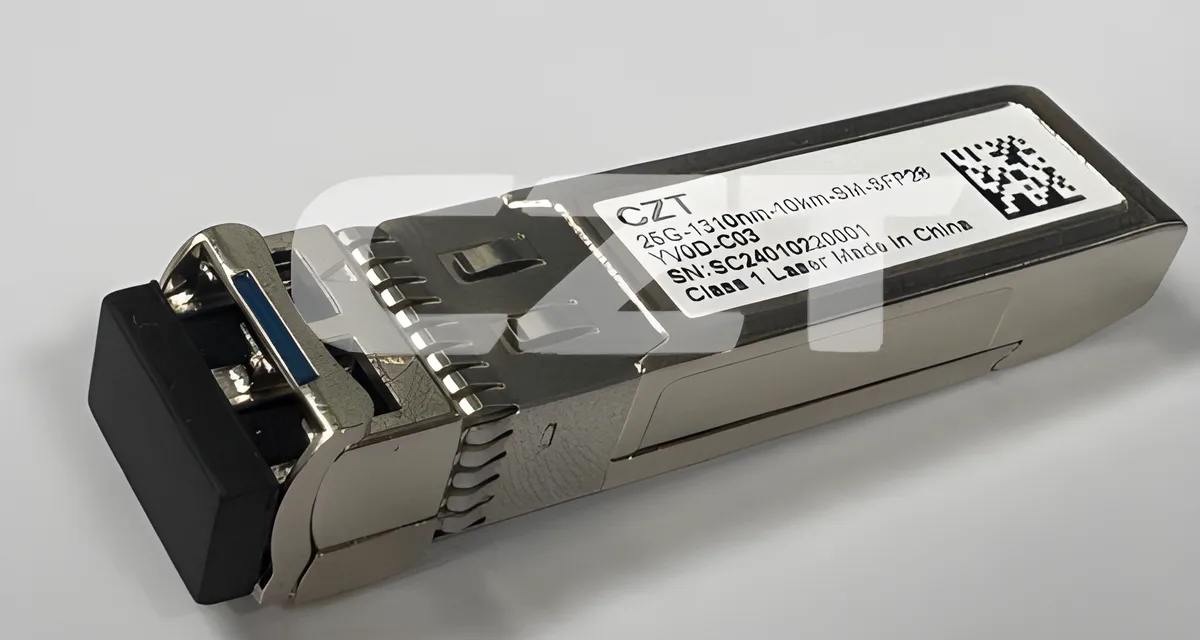
Coherent optics is the technology behind long-haul internet backbone networks, submarine cables, and increasingly, metro and data center interconnect (DCI) links. This guide explains how it works and when you need it.
Direct Detection vs Coherent Detection
Direct Detection (Intensity Modulation)
Traditional optical transceivers use intensity modulation / direct detection (IM-DD):
- The laser turns on and off (or varies in intensity) to encode bits
- The receiver measures light power — bright = 1, dark = 0
- Simple, low-cost, low power
- Limited to ~100 Gbps per wavelength over short distances
Coherent Detection
Coherent transceivers use the full properties of light:
- Phase: The timing of the light wave's oscillation
- Amplitude: The intensity of the wave
- Polarization: The orientation of the wave (horizontal and vertical)
By encoding data in all three dimensions simultaneously, coherent systems achieve much higher spectral efficiency — more bits per Hz of optical bandwidth.
How Coherent Transmission Works
1. Modulation Formats
| Format | Bits per Symbol | Spectral Efficiency | Typical Use |
|---|---|---|---|
| BPSK | 1 | Low | Long-haul, high noise tolerance |
| QPSK | 2 | Medium | 100G long-haul |
| DP-QPSK | 4 (2 pol × 2) | Medium-high | 100G standard |
| 16-QAM | 4 | High | 200G/400G metro |
| DP-16QAM | 8 | Very high | 400G |
| 64-QAM | 6 | Very high | 800G, short reach |
| DP-64QAM | 12 | Highest | 800G+ |
DP-QPSK (Dual-Polarization Quadrature Phase Shift Keying) was the workhorse of 100G coherent. It uses two polarizations (X and Y) each carrying QPSK-modulated data — 4 bits per symbol total.
Higher QAM orders pack more bits per symbol but require better signal-to-noise ratio (SNR), limiting reach.
2. Digital Signal Processing (DSP)
The key enabler of coherent optics is the coherent DSP ASIC — a specialized chip that:
- Generates the complex modulated signal at the transmitter
- Recovers the signal at the receiver using digital algorithms
- Compensates for chromatic dispersion (CD) — no external DCM modules needed
- Compensates for polarization mode dispersion (PMD)
- Performs forward error correction (FEC)
Modern coherent DSPs (from companies like Acacia, Inphi/Marvell, Ciena) can compensate for thousands of kilometers of accumulated dispersion in real time.
3. Local Oscillator Laser
The receiver uses a local oscillator (LO) laser — a narrow-linewidth laser tuned to the same frequency as the incoming signal. Mixing the received signal with the LO laser allows phase detection, which is impossible with direct detection.
Key Coherent Transceiver Form Factors
CFP / CFP2 / CFP4
Early 100G coherent form factors. Large, high power consumption. Mostly legacy.
QSFP28 Coherent
100G coherent in a QSFP28 form factor. Used for metro DCI. Examples: Cisco CPAK, Ciena WaveLogic Nano.
QSFP-DD / OSFP (400G ZR/ZR+)
The current generation for 400G coherent:
- 400G ZR (OpenROADM / OIF standard): Up to 120 km, pluggable, interoperable
- 400G ZR+: Extended reach (500–1,000 km), vendor-specific enhancements
- Form factors: QSFP-DD, OSFP
- Power: 15–20 W per module
800G and Beyond
800G coherent modules (OSFP, QSFP-DD800) are entering production. They use DP-64QAM or probabilistic constellation shaping (PCS) to achieve 800 Gbps per wavelength.
Coherent DWDM: Multiplying Capacity
Coherent transceivers are almost always used with DWDM (Dense Wavelength Division Multiplexing), which combines multiple wavelengths on a single fiber:
- C-band: 1,530–1,565 nm, ~96 channels at 50 GHz spacing
- L-band: 1,565–1,625 nm, additional ~96 channels
- C+L band: ~192 channels × 400 Gbps = ~76.8 Tbps per fiber pair
Each wavelength carries an independent coherent channel. A single fiber pair can carry petabits per second in theory.
Coherent vs Direct Detect: When to Use Each
| Scenario | Recommended |
|---|---|
| Intra-datacenter (<2 km) | Direct detect (SR4, DR4) |
| Campus / short reach (2–10 km) | Direct detect (LR4, FR4) |
| Metro DCI (10–80 km) | Coherent ZR or direct detect (ER4) |
| Regional (80–300 km) | Coherent ZR / ZR+ |
| Long-haul (300–3,000 km) | Coherent with EDFA amplification |
| Submarine (3,000–20,000 km) | Coherent with Raman + EDFA |
The crossover point where coherent becomes cost-effective has been dropping. 400G ZR modules now make coherent viable for metro DCI links that previously used direct-detect solutions.
Amplification: EDFAs and Raman
Coherent signals still attenuate over distance. Two amplification technologies extend reach:
EDFA (Erbium-Doped Fiber Amplifier)
- Amplifies all C-band wavelengths simultaneously
- Placed every 60–100 km on long-haul routes
- Adds noise (OSNR degradation) with each stage
- Standard technology for terrestrial long-haul
Raman Amplification
- Uses the fiber itself as the gain medium
- Distributed amplification — lower noise accumulation
- Used in submarine cables and ultra-long-haul terrestrial routes
- Often combined with EDFA (hybrid Raman/EDFA)
OSNR: The Key Performance Metric
Optical Signal-to-Noise Ratio (OSNR) determines how far a coherent signal can travel before errors become unacceptable. Higher modulation formats (64-QAM) require higher OSNR than lower formats (QPSK).
The coherent DSP's FEC (Forward Error Correction) can recover signals with very high bit error rates (pre-FEC BER up to 2×10⁻² for soft-decision FEC), dramatically extending reach.
Summary
Coherent optics enables high-capacity, long-distance optical transmission by encoding data in the phase, amplitude, and polarization of light — not just its intensity. Key takeaways:
- DP-QPSK is the standard for 100G long-haul; DP-16QAM and DP-64QAM for 400G/800G
- Coherent DSP ASICs handle dispersion compensation digitally — no external DCM needed
- 400G ZR/ZR+ in QSFP-DD form factor is the current standard for pluggable coherent
- Use coherent for metro DCI (10+ km) and all long-haul applications
- DWDM multiplies capacity: C+L band can carry 100+ Tbps per fiber pair
CZT supplies fiber optic transceivers and connectivity solutions for data center and telecom applications. Browse our fiber optic connector and transceiver range for compatible products.


