An optical transceiver is the bridge between your network equipment and the fiber optic cable. It converts electrical signals from a switch or router into light pulses for transmission, and converts incoming light back to electrical signals at the other end. Choosing the wrong transceiver — wrong reach, wrong wavelength, wrong form factor — means no link.
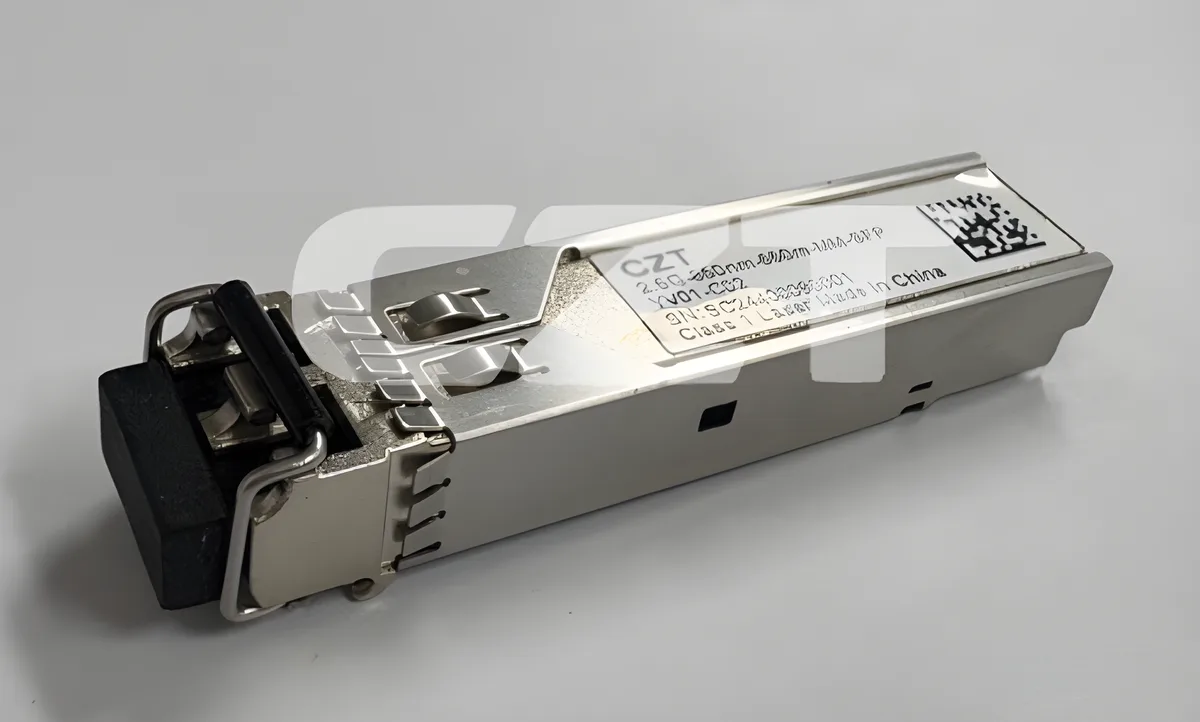
This guide covers every major transceiver type, how to read the specs, and how to match a transceiver to your application.
How an Optical Transceiver Works
Every optical transceiver contains:
- Laser (transmitter): Converts electrical signal to light. Common types: VCSEL (short reach), FP (Fabry-Perot, medium reach), DFB (Distributed Feedback, long reach), EML (Electro-absorption Modulated Laser, very long reach)
- Photodetector (receiver): Converts incoming light to electrical signal. Common types: PIN photodiode, APD (Avalanche Photodiode, higher sensitivity)
- Driver/TIA circuits: Amplify and condition the signals
- Housing: The pluggable form factor (SFP, QSFP, etc.)
The transceiver plugs into a cage on the network device. The fiber connects to the transceiver's LC, SC, or MPO port.
Form Factors
SFP (Small Form-factor Pluggable)
- Speed: 100 Mbps to 1 Gbps (1G SFP)
- Interface: LC duplex (most common), RJ45 (copper SFP)
- Standard: SFF-8472
- Use: Access switches, 1G uplinks, legacy equipment
SFP+ (Enhanced SFP)
- Speed: 10 Gbps
- Interface: LC duplex
- Standard: SFF-8431
- Use: 10G server connections, ToR switches, 10G uplinks
- Backward compatible: SFP+ ports accept 1G SFP modules (at reduced speed)
SFP28
- Speed: 25 Gbps
- Interface: LC duplex
- Standard: SFF-8402
- Use: 25G server connections, spine-leaf fabric
- Backward compatible: Accepts SFP+ (10G) and SFP (1G)
QSFP+ (Quad SFP+)
- Speed: 40 Gbps (4 × 10G lanes)
- Interface: MPO-12 (parallel) or LC duplex (via WDM)
- Standard: SFF-8436
- Use: 40G uplinks, spine switches
QSFP28
- Speed: 100 Gbps (4 × 25G lanes)
- Interface: MPO-12 (parallel) or LC duplex (via WDM)
- Standard: SFF-8665
- Use: 100G server connections, spine-leaf, DCI
- Most common 100G form factor
QSFP56
- Speed: 200 Gbps (4 × 50G PAM4 lanes)
- Interface: MPO-12 or LC duplex
- Use: 200G links, transitional technology
QSFP-DD (Double Density)
- Speed: 400 Gbps (8 × 50G PAM4 lanes)
- Interface: MPO-16, MPO-12, or LC duplex
- Standard: QSFP-DD MSA
- Use: 400G spine switches, DCI, coherent ZR
- Backward compatible: Accepts QSFP28, QSFP56, QSFP+
OSFP (Octal SFP)
- Speed: 400 Gbps to 800 Gbps
- Interface: MPO-16 or LC duplex
- Use: 400G/800G hyperscale switches
- Larger than QSFP-DD, better thermal performance
CFP / CFP2 / CFP4
- Speed: 100G to 400G
- Use: Coherent long-haul, legacy 100G
- Larger form factor, mostly replaced by QSFP-DD for new deployments
Reach Categories
| Category | Abbreviation | Typical Distance | Fiber Type |
|---|---|---|---|
| Short Reach | SR | 70–400 m | Multimode (OM3/OM4) |
| Intermediate Reach | IR | 2 km | Single-mode |
| Long Reach | LR | 10 km | Single-mode |
| Extended Reach | ER | 40 km | Single-mode |
| Zone Reach | ZR | 80 km | Single-mode |
| ZR+ | ZR+ | 120–1,000 km | Single-mode + amplification |
SR (Short Reach)
Uses VCSEL lasers and multimode fiber. Low cost, low power. Examples: 10GBASE-SR, 100GBASE-SR4, 400GBASE-SR8.
LR (Long Reach)
Uses DFB or EML lasers and single-mode fiber. 10 km reach. Examples: 10GBASE-LR, 100GBASE-LR4, 400GBASE-LR8.
ER (Extended Reach)
40 km on single-mode. Higher power, more expensive. Examples: 10GBASE-ER, 100GBASE-ER4.
ZR (Zone Reach)
80 km on single-mode. Used for metro DCI. Examples: 100GBASE-ZR (coherent), 400G ZR (OpenZR+).
Wavelengths
| Application | Wavelength | Notes |
|---|---|---|
| Multimode SR | 850 nm | VCSEL, low cost |
| Single-mode LR | 1,310 nm | Low dispersion |
| Single-mode ER/ZR | 1,550 nm | Low attenuation |
| CWDM | 1,270–1,610 nm | 8 channels, 20 nm spacing |
| DWDM | 1,528–1,565 nm | 96 channels, 0.8 nm spacing |
| BiDi | 1,270/1,330 nm or 1,490/1,550 nm | Single fiber, two wavelengths |
BiDi (Bidirectional) transceivers use a WDM filter to transmit and receive on different wavelengths over a single fiber strand — halving fiber count.
Single-Mode vs Multimode
| Multimode | Single-Mode | |
|---|---|---|
| Core diameter | 50 µm (OM3/OM4) | 9 µm |
| Max distance | 400 m (100G SR4) | 10–80+ km |
| Laser type | VCSEL (850 nm) | DFB/EML (1310/1550 nm) |
| Cost | Lower | Higher |
| Typical use | Intra-datacenter | Campus, metro, long-haul |
For new data center builds, OM4 or OM5 multimode is standard for intra-DC links up to 100 m. Single-mode is used for anything longer.
DOM: Digital Optical Monitoring
Most modern transceivers support DOM (Digital Optical Monitoring), also called DDM (Digital Diagnostic Monitoring). DOM provides real-time readings of:
- TX power (transmit optical power, dBm)
- RX power (receive optical power, dBm)
- Temperature (°C)
- Supply voltage (V)
- Bias current (mA)
DOM data is accessible via the I²C interface (SFF-8472 for SFP, SFF-8636 for QSFP). Network management software can alert on out-of-range values before a link fails.
OEM vs Third-Party Transceivers
Network equipment vendors (Cisco, Juniper, Arista, etc.) sell branded transceivers at significant premiums. Third-party transceivers are programmed with the vendor's OUI (Organizationally Unique Identifier) to pass compatibility checks.
| Factor | OEM | Third-Party |
|---|---|---|
| Cost | 3–10× higher | Lower |
| Warranty support | Full vendor support | Varies |
| Compatibility | Guaranteed | Usually works; some vendors block |
| Quality | High | Varies by supplier |
Most enterprises use third-party transceivers successfully. Cisco's "unsupported transceiver" warning can be suppressed with service unsupported-transceiver on IOS. Arista and Juniper are generally more open.
How to Choose a Transceiver
- Match the form factor to your equipment's port type (SFP, SFP+, QSFP28, etc.)
- Determine the distance — SR for <400 m, LR for <10 km, ER for <40 km
- Choose fiber type — multimode for short reach, single-mode for longer
- Check the speed — must match the port speed (1G, 10G, 25G, 100G, 400G)
- Verify wavelength compatibility — both ends must use compatible wavelengths
- Check DOM support if you need monitoring
- Verify vendor compatibility if using OEM-locked equipment
Summary
Optical transceivers are available in a wide range of form factors (SFP to QSFP-DD), speeds (1G to 800G), and reach categories (SR to ZR+). The right choice depends on your port type, distance, fiber type, and budget.
Key rules:
- SR + multimode for intra-datacenter (<400 m)
- LR + single-mode for campus and inter-building (up to 10 km)
- ER/ZR + single-mode for metro and DCI (up to 80 km)
- Coherent ZR+ for long-haul (80 km+)
- QSFP28 is the dominant 100G form factor; QSFP-DD for 400G
CZT supplies fiber optic transceivers, connectors, and cabling solutions for data center and enterprise networks. Browse our fiber optic product range for compatible transceivers and accessories.


