If you're new to fiber optic networking, the terminology can be confusing. "Transceiver," "SFP," "SFP+," "QSFP28," "module" — these terms are often used interchangeably, but they mean different things. Understanding the relationship between them is the first step to specifying the right hardware for your network.
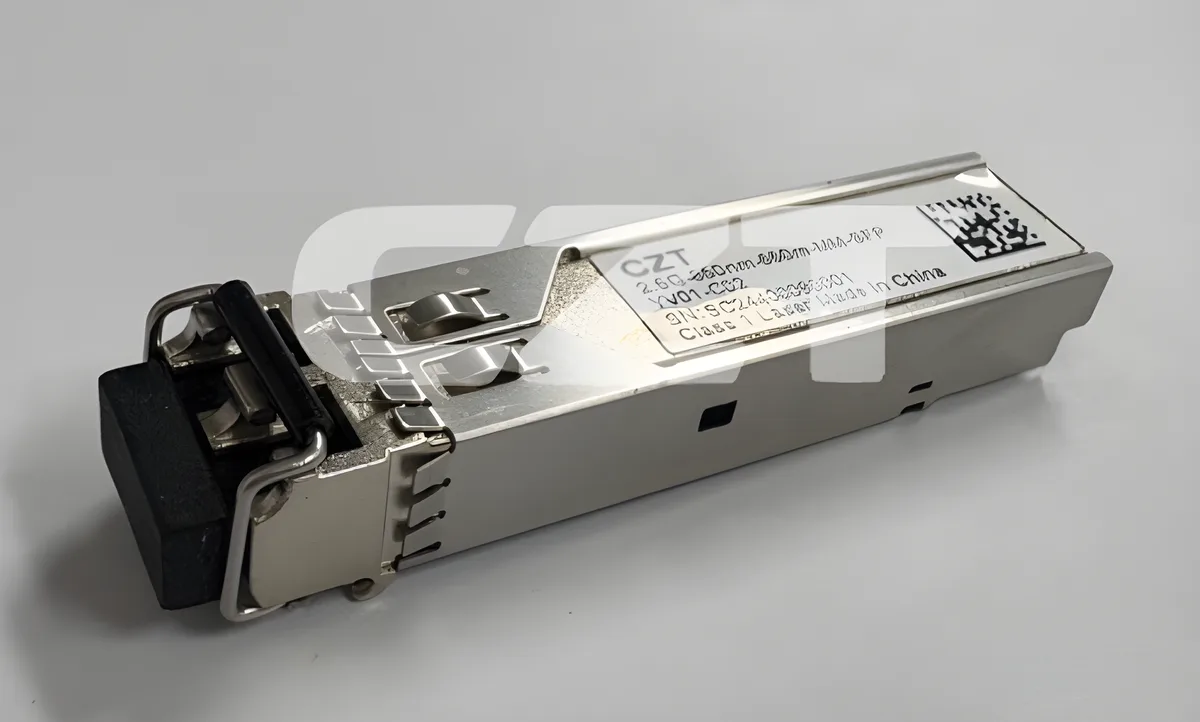
What Is a Transceiver?
A transceiver is a device that both transmits and receives signals. The word is a portmanteau of transmitter + receiver.
In optical networking, a transceiver:
- Transmits: Converts electrical signals from a switch or router into light pulses sent down a fiber
- Receives: Converts incoming light pulses back into electrical signals
Every fiber optic link needs a transceiver at each end. The transceivers must be compatible — same wavelength, same speed, same fiber type.
What Is an SFP?
SFP stands for Small Form-factor Pluggable. It's a specific form factor (physical size and connector standard) for optical transceivers.
So: SFP is a type of transceiver — specifically, a pluggable transceiver in the SFP form factor.
The SFP family has evolved over time:
| Form Factor | Speed | Lanes | Common Name |
|---|---|---|---|
| SFP | 100M–1G | 1 | Gigabit SFP, GbE SFP |
| SFP+ | 10G | 1 | 10G SFP+ |
| SFP28 | 25G | 1 | 25G SFP28 |
| SFP56 | 50G | 1 | 50G SFP56 |
| QSFP+ | 40G | 4 × 10G | 40G QSFP |
| QSFP28 | 100G | 4 × 25G | 100G QSFP28 |
| QSFP56 | 200G | 4 × 50G | 200G QSFP56 |
| QSFP-DD | 400G | 8 × 50G | 400G QSFP-DD |
| OSFP | 400–800G | 8 lanes | 400G/800G OSFP |
The "Q" in QSFP stands for Quad — four lanes. QSFP-DD has Double Density — eight lanes.
Transceiver vs Module vs SFP: Are They the Same?
In everyday usage, these terms are often used interchangeably:
- "Transceiver" — the generic term for any device that transmits and receives
- "Module" — informal term for a pluggable transceiver (as in "SFP module")
- "SFP" — technically refers to the 1G form factor, but often used loosely to mean any SFP-family transceiver
- "Optic" — informal term used in data center contexts ("plug in the optic")
When someone says "I need an SFP for my 10G switch," they usually mean an SFP+ (10G form factor). Context matters.
Fixed vs Pluggable Transceivers
Fixed (Non-Pluggable)
Some network equipment has transceivers built into the device — they cannot be removed or replaced. Common in consumer-grade switches and some enterprise access switches.
Disadvantages: If the transceiver fails or you need a different reach/wavelength, you must replace the entire device.
Pluggable (Hot-Swappable)
SFP, QSFP, and other form-factor transceivers plug into cages on the network device. They can be swapped without powering down the device.
Advantages:
- Choose the right transceiver for each link (SR, LR, ER, CWDM, DWDM)
- Replace failed transceivers without replacing the switch
- Upgrade speeds by replacing transceivers (where the port supports it)
- Mix fiber and copper (copper SFP modules use RJ45 instead of LC)
All enterprise and data center switches use pluggable transceivers.
How to Read a Transceiver Part Number
Transceiver part numbers encode key specifications. Example: SFP-10G-LR
| Part | Meaning |
|---|---|
| SFP | Form factor (SFP+ in this case — "SFP" is often used loosely) |
| 10G | Speed: 10 Gigabit |
| LR | Reach: Long Reach (10 km, single-mode) |
Common reach codes:
- SR — Short Reach (multimode, 70–400 m)
- LR — Long Reach (single-mode, 10 km)
- ER — Extended Reach (single-mode, 40 km)
- ZR — Zone Reach (single-mode, 80 km)
- LRM — Long Reach Multimode (legacy, 220 m on OM1)
- CWDM — Coarse WDM (specific wavelength, 40–80 km)
- DWDM — Dense WDM (ITU grid wavelength, long-haul)
- BiDi — Bidirectional (single fiber, two wavelengths)
Copper SFP vs Fiber SFP
Not all SFP transceivers use fiber. Copper SFP (also called RJ45 SFP or 1000BASE-T SFP) uses a standard RJ45 connector and Cat5e/Cat6 cable.
| Fiber SFP | Copper SFP | |
|---|---|---|
| Connector | LC duplex | RJ45 |
| Cable | Fiber optic | Cat5e/Cat6 |
| Max distance | 550 m (SR) to 80+ km | 100 m |
| Power consumption | Lower | Higher (~1 W) |
| Cost | Varies | Lower |
| Use case | Long distance, EMI immunity | Short copper runs |
Copper SFPs are useful when you need to connect a fiber-only switch to a copper-only device over a short distance.
BiDi Transceivers: One Fiber, Two Directions
Standard fiber links use two fibers — one for TX, one for RX. BiDi (Bidirectional) transceivers use a single fiber by transmitting and receiving on different wavelengths:
- TX: 1,270 nm → RX: 1,330 nm (one end)
- TX: 1,330 nm → RX: 1,270 nm (other end)
BiDi transceivers must be used in matched pairs — the TX wavelength of one must match the RX wavelength of the other. They halve fiber consumption, which matters in high-density or long-haul deployments.
CWDM and DWDM Transceivers
CWDM (Coarse Wavelength Division Multiplexing)
- 8 channels at 20 nm spacing (1,270–1,610 nm)
- Up to 80 km on single-mode fiber
- Lower cost than DWDM
- Used for metro and campus WDM
DWDM (Dense Wavelength Division Multiplexing)
- Up to 96 channels at 0.8 nm (100 GHz) spacing
- Tunable or fixed wavelength
- Used with EDFA amplifiers for long-haul
- Enables Tbps capacity on a single fiber pair
CWDM/DWDM transceivers allow multiple independent channels on one fiber pair — multiplying capacity without laying more fiber.
Transceiver Compatibility
Vendor Lock-In
Cisco, Juniper, Arista, and other vendors program their switches to check transceiver vendor IDs. A "foreign" transceiver may trigger a warning or be blocked.
Workarounds:
- Cisco IOS:
service unsupported-transceiversuppresses the warning - Arista EOS: Generally open, accepts third-party transceivers
- Juniper: Accepts third-party with
no-transceiver-checkflag
DOM (Digital Optical Monitoring)
Most modern transceivers support DOM — real-time monitoring of TX power, RX power, temperature, voltage, and bias current. Verify DOM support if you need monitoring capability.
Speed Compatibility
SFP+ ports are backward compatible with SFP (1G) modules. QSFP28 ports typically accept QSFP+ (40G) modules. Always verify with the switch datasheet.
Summary
- A transceiver transmits and receives — it's the generic term
- SFP is a specific pluggable form factor; the SFP family spans 1G to 50G per lane
- QSFP uses 4 lanes; QSFP-DD uses 8 lanes for 400G
- Pluggable transceivers let you choose the right reach and wavelength for each link
- SR = multimode short reach; LR = single-mode 10 km; ER/ZR = longer reach
- BiDi uses one fiber; CWDM/DWDM multiplies capacity on one fiber pair
CZT supplies fiber optic transceivers and connectivity solutions for data center and enterprise networks. Browse our fiber optic product range for SFP, SFP+, QSFP28, and compatible accessories.


