Fiber optic networks form the backbone of modern telecommunications, data centers, and enterprise infrastructure. At every junction where fiber cables meet active equipment, a small but critical component makes the connection possible: the fiber optic connector.
Choosing the wrong connector type can lead to excessive signal loss, compatibility headaches, and costly rework. Choosing the right one ensures reliable performance, easier maintenance, and room to scale.
This guide covers the four most widely deployed fiber connector types — LC, SC, ST, and FC — along with their specifications, ideal applications, and the key differences that matter when you're designing or upgrading a network. Whether you're specifying components for a hyperscale data center or a campus LAN, understanding these fiber connector types is the first step toward a sound design.

What Is a Fiber Optic Connector?
A fiber optic connector is a mechanical device that attaches to the end of a fiber optic cable, allowing it to be quickly connected to and disconnected from another fiber, a patch panel, or a piece of active network equipment such as a switch, router, or media converter.
How It Works
At the heart of every fiber connector is a ferrule — a thin, precision-machined cylinder (usually ceramic, but sometimes metal or polymer) that holds the glass or plastic fiber core in exact alignment. When two connectors are mated inside an adapter (also called a coupler or bulkhead), their ferrules press together so the fiber cores align with micron-level accuracy. This alignment is what allows light to pass from one fiber to the other with minimal loss.
Key performance metrics for any fiber connector include:
- Insertion loss — the amount of optical power lost when light passes through the mated connection, measured in decibels (dB). Lower is better.
- Return loss — the amount of light reflected back toward the source, also in dB. Higher return loss values indicate less reflection, which is better.
- Repeatability — how consistently the connector performs across hundreds or thousands of mating cycles.
Different connector types vary in ferrule diameter, latching mechanism, form factor, and polishing style. These differences determine where each type fits best in real-world networks.

LC Connector
The LC (Lucent Connector) was developed by Lucent Technologies in the late 1990s and has since become the dominant connector in modern data center and enterprise environments. Its compact form factor — roughly half the footprint of an SC connector — makes it the go-to choice wherever port density matters.
Key Features
- 1.25 mm ferrule diameter — the small ferrule enables a compact housing.
- Push-pull latching mechanism — a retaining tab clicks into place and releases with a simple squeeze, making insertion and removal fast and tool-free.
- Duplex configuration — two LC connectors are commonly joined in a duplex clip, supporting simultaneous transmit and receive over a pair of fibers.
- Available in single-mode and multi-mode variants with UPC or APC polish.
Specifications
| Parameter | Value |
|---|---|
| Ferrule diameter | 1.25 mm |
| Fiber compatibility | Single-mode (OS1/OS2), Multi-mode (OM1–OM5) |
| Typical insertion loss | 0.10 – 0.20 dB |
| Typical return loss | ≥ 50 dB (UPC), ≥ 65 dB (APC) |
| Mating cycles | 500+ |
| Latching mechanism | Push-pull tab |
| Body size | 6.25 mm x 6.25 mm (per simplex) |
| Polish types | UPC (blue), APC (green) |
Applications
- Data centers — LC connectors are the standard interface for SFP, SFP+, SFP28, and QSFP transceivers, which are the workhorses of 1G through 100G Ethernet.
- High-density patch panels — the small footprint allows up to 72 duplex ports in a single 1U rack panel.
- Structured cabling — widely specified in TIA-568 and ISO/IEC 11801 standards for enterprise LAN backbone and horizontal cabling.
- FTTH (Fiber to the Home) — increasingly used in ONT (Optical Network Terminal) connections.
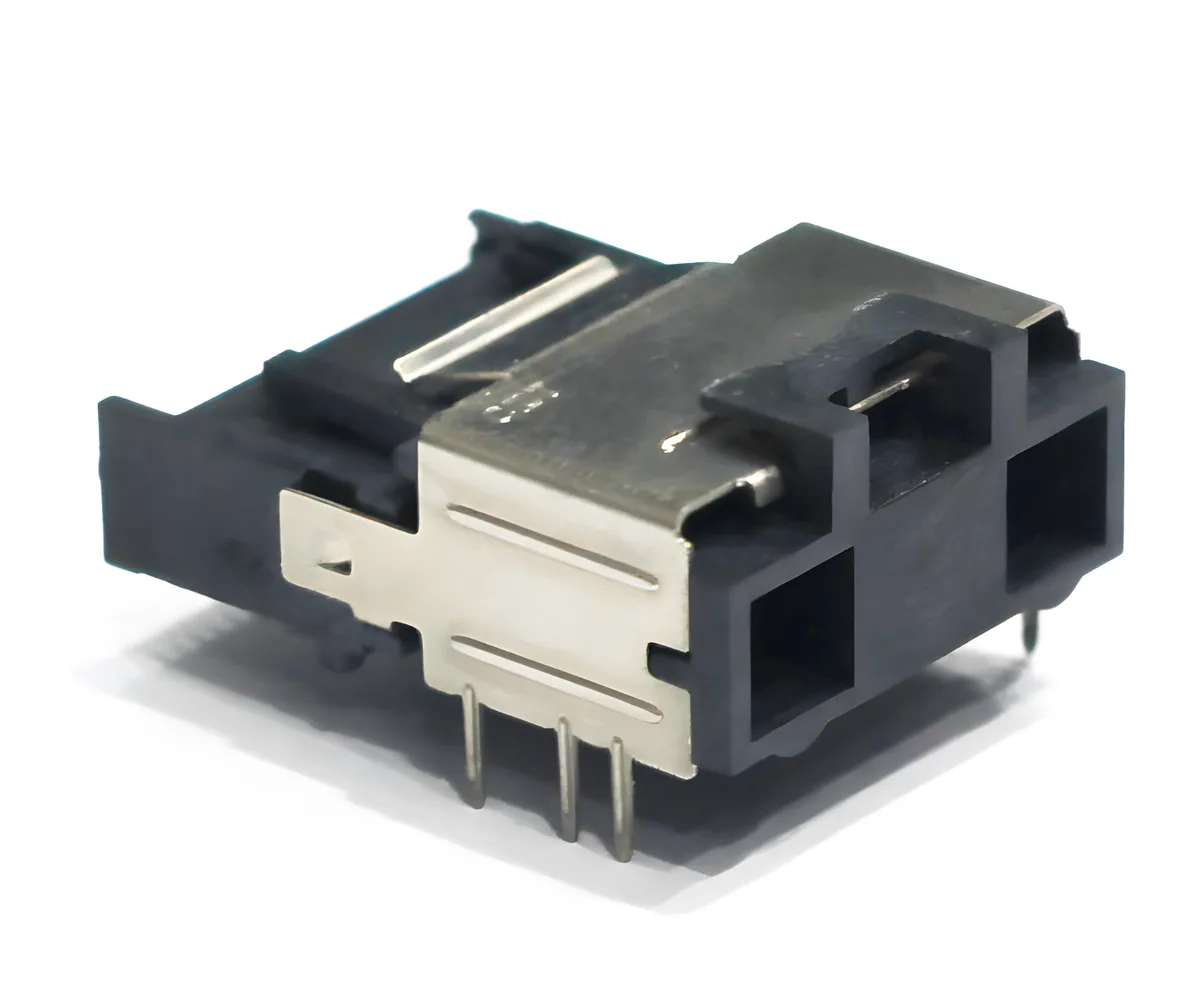
The LC connector's combination of small size, low loss, and broad ecosystem support has made it the most popular fiber connector type deployed today. If you're building a new network from scratch, LC is almost always the default starting point.
SC Connector
The SC (Subscriber Connector), sometimes called the "Standard Connector," was developed by NTT (Nippon Telegraph and Telephone) in the 1980s. It was one of the first connectors to use a push-pull coupling mechanism, which was a significant improvement over the threaded and bayonet designs that preceded it.
Key Features
- 2.5 mm ferrule diameter — the same ferrule size used by ST and FC connectors, but housed in a square, snap-in body.
- Push-pull latching — the connector clicks into the adapter and releases with a straight pull, eliminating the need to twist or unscrew.
- Simplex and duplex — available as single connectors or joined in a duplex clip.
- Robust and easy to use — the larger body is easier to handle, especially in field installations.
Specifications
| Parameter | Value |
|---|---|
| Ferrule diameter | 2.5 mm |
| Fiber compatibility | Single-mode (OS1/OS2), Multi-mode (OM1–OM5) |
| Typical insertion loss | 0.20 – 0.30 dB |
| Typical return loss | ≥ 50 dB (UPC), ≥ 60 dB (APC) |
| Mating cycles | 1,000+ |
| Latching mechanism | Push-pull snap |
| Body size | 9 mm x 9 mm (per simplex) |
| Polish types | UPC (blue), APC (green) |
Applications
- FTTH / PON networks — SC/APC connectors (green) are the standard interface at the OLT and ONT in GPON and XGS-PON deployments worldwide.
- Telecom central offices — widely used in optical distribution frames (ODFs) and splice enclosures.
- Cable television (CATV) — common in headend and distribution plant fiber connections.
- Legacy enterprise networks — still found in many campus backbone installations deployed before the LC connector gained dominance.
The SC connector remains a workhorse in telecom and FTTH applications. Its larger size is actually an advantage in outside plant and central office environments where technicians wear gloves and need a connector that's easy to grip and align.
ST Connector
The ST (Straight Tip) connector was developed by AT&T (now part of Nokia/Lucent) and was the dominant fiber connector in enterprise LANs throughout the 1990s. It uses a bayonet-style twist-lock coupling that will be familiar to anyone who has worked with BNC coaxial connectors.
Key Features
- 2.5 mm ferrule diameter — ceramic ferrule, same size as SC and FC.
- Bayonet mount — insert and twist a quarter turn to lock; reverse to release.
- Spring-loaded ferrule — ensures consistent physical contact between mated ferrules.
- Simplex only — ST connectors are always single-fiber; there is no standard duplex clip.
Specifications
| Parameter | Value |
|---|---|
| Ferrule diameter | 2.5 mm |
| Fiber compatibility | Single-mode, Multi-mode (OM1–OM3 most common) |
| Typical insertion loss | 0.25 – 0.50 dB |
| Typical return loss | ≥ 40 dB (UPC) |
| Mating cycles | 500+ |
| Latching mechanism | Bayonet twist-lock |
| Body size | Round, ~9.5 mm diameter |
| Polish types | UPC (most common) |
Applications
- Legacy campus LANs — many buildings wired in the 1990s and early 2000s still have ST-terminated multi-mode fiber in the walls and patch panels.
- Industrial and military — the bayonet lock provides a secure connection that resists vibration, making ST connectors suitable for some industrial environments.
- Security and CCTV — older analog-to-fiber media converters often use ST interfaces.
The ST connector is considered a legacy type. New installations rarely specify ST, but it remains in widespread use in existing infrastructure. If you're maintaining or extending an older network, you may need ST-compatible patch cords and adapters for backward compatibility.

FC Connector
The FC (Ferrule Connector), sometimes called the "Fixed Connector" or "Fiber Channel connector," was one of the earliest fiber optic connectors to use a ceramic ferrule. Developed in Japan, it features a threaded screw-on coupling that provides the most secure mechanical connection of any standard fiber connector.
Key Features
- 2.5 mm ferrule diameter — precision ceramic ferrule, same as SC and ST.
- Screw-on coupling — a threaded metal nut tightens onto the adapter, creating a vibration-resistant, highly repeatable connection.
- Keyed alignment — a notch on the connector body aligns with a key on the adapter, ensuring consistent rotational orientation of the ferrule.
- Simplex only — like the ST, FC connectors are single-fiber.
Specifications
| Parameter | Value |
|---|---|
| Ferrule diameter | 2.5 mm |
| Fiber compatibility | Single-mode (most common), Multi-mode |
| Typical insertion loss | 0.10 – 0.20 dB |
| Typical return loss | ≥ 50 dB (UPC), ≥ 65 dB (APC) |
| Mating cycles | 1,000+ |
| Latching mechanism | Screw-on threaded nut |
| Body size | Round, ~9.5 mm diameter |
| Polish types | UPC, APC |
Applications
- Test and measurement equipment — optical power meters, OTDRs, and light sources frequently use FC interfaces because the screw-on coupling delivers highly repeatable, low-loss connections.
- Telecom long-haul and DWDM — FC/APC connectors are used in applications where return loss performance is critical, such as DWDM mux/demux modules and EDFA amplifiers.
- Broadcast and RF-over-fiber — analog video and RF signal transport systems often specify FC connectors for their low reflection characteristics.
- Military and aerospace — the threaded coupling resists vibration and accidental disconnection.
While FC connectors are being gradually replaced by LC and SC in many new installations, they remain the gold standard in precision measurement and any application where the absolute lowest insertion loss and highest return loss are required.
Other Fiber Connector Types
Beyond the four major types, several specialized connectors serve niche or emerging applications.
MPO/MTP
The MPO (Multi-fiber Push-On) connector, and its enhanced version the MTP (a registered trademark of US Conec), can terminate 8, 12, 24, or even 72 fibers in a single rectangular ferrule. MPO/MTP connectors are essential for:
- 40G and 100G parallel optics — QSFP+ and QSFP28 transceivers use MPO-12 or MPO-8 interfaces.
- High-density trunk cabling — a single MPO-24 cable replaces 12 duplex LC patch cords.
- Data center spine-leaf architectures — MPO trunk cables connect top-of-rack switches to leaf/spine switches with minimal cable management overhead.
E2000
The E2000 (also known as LSH) is a push-pull connector with a built-in spring-loaded dust cap that automatically covers the ferrule when the connector is removed. It's specified in some European telecom networks and in applications where contamination control is critical.
MTRJ
The MTRJ (Mechanical Transfer Registered Jack) is a small-form-factor duplex connector that houses two fibers in a single ferrule. It was designed as a lower-cost alternative to duplex LC and SC connectors but never achieved widespread adoption. It's occasionally found in older enterprise switches and patch panels.

Fiber Optic Connector Comparison Table
The table below summarizes the key differences among the four major fiber connector types, plus MPO/MTP for reference.
| Feature | LC | SC | ST | FC | MPO/MTP |
|---|---|---|---|---|---|
| Ferrule diameter | 1.25 mm | 2.5 mm | 2.5 mm | 2.5 mm | Rectangular (multi-fiber) |
| Latching mechanism | Push-pull tab | Push-pull snap | Bayonet twist | Screw-on | Push-pull |
| Typical insertion loss | 0.10–0.20 dB | 0.20–0.30 dB | 0.25–0.50 dB | 0.10–0.20 dB | 0.25–0.50 dB |
| Typical return loss (UPC) | ≥ 50 dB | ≥ 50 dB | ≥ 40 dB | ≥ 50 dB | ≥ 35 dB |
| Duplex available | Yes (clip) | Yes (clip) | No | No | N/A (multi-fiber) |
| Fibers per connector | 1 (simplex) or 2 (duplex) | 1 or 2 | 1 | 1 | 8, 12, 24, or 72 |
| APC version available | Yes | Yes | Rare | Yes | Yes |
| Mating cycles | 500+ | 1,000+ | 500+ | 1,000+ | 200+ |
| Relative size | Small | Medium | Medium | Medium | Medium |
| Relative cost | $$ | $ | $ | $$$ | $$$$ |
| Primary use today | Data centers, SFP transceivers | FTTH, telecom | Legacy LAN | Test equipment, precision | 40G/100G parallel optics |
| Trend | Growing | Stable | Declining | Declining | Growing |
This comparison makes it clear that LC and SC dominate new deployments, while ST and FC serve legacy and specialized roles. MPO/MTP is the fastest-growing category, driven by the shift to 40G, 100G, and 400G data center speeds.
How to Choose the Right Fiber Connector
Selecting the right fiber connector type comes down to five practical criteria.
1. Application and Environment
Start with where the connector will be used:
- Data center or server room — LC is the standard. SFP/SFP+ transceivers use LC interfaces, and high-density patch panels are designed around the LC form factor.
- Telecom central office or FTTH — SC/APC is the dominant choice for PON networks. SC/UPC is common in central office patching.
- Test lab or precision measurement — FC remains preferred for its repeatable screw-on coupling.
- Legacy network extension — match the existing connector type (often ST or SC) to avoid adapter complexity.
2. Port Density Requirements
If rack space is limited and you need to maximize the number of fiber ports per unit, LC is the clear winner. A 1U LC patch panel can hold 72 duplex ports, compared to 24 duplex SC ports in the same space. For ultra-high-density applications, MPO/MTP trunk cabling with LC breakout cassettes offers the best of both worlds.
3. Performance Requirements
For most standard networking applications, all four connector types provide adequate insertion loss and return loss. However:
- If you need the lowest possible insertion loss for long-haul or DWDM links, FC/APC or LC/APC connectors with factory-polished ferrules are the best choice.
- If return loss is critical (e.g., analog CATV, RF-over-fiber), specify APC polish regardless of connector type.
4. Compatibility with Existing Infrastructure
Mixing connector types within a network is possible using hybrid adapters (e.g., LC-to-SC), but every adapter adds insertion loss (typically 0.3–0.5 dB) and a potential point of failure. Whenever possible, standardize on a single connector type across your infrastructure.
5. Budget
SC and ST connectors are generally the least expensive per unit. LC connectors cost slightly more but deliver better density, which can reduce overall infrastructure cost. FC connectors carry a premium due to their precision machining. MPO/MTP connectors are the most expensive per unit but can reduce total cabling cost in high-fiber-count applications.
Single-Mode vs Multi-Mode Connectors
A common source of confusion is the relationship between connector type and fiber type. Here's the key point: LC, SC, ST, and FC connectors are all available in both single-mode and multi-mode versions. The connector type and the fiber type are independent choices.
Single-Mode Fiber (SMF)
- Core diameter: 9 µm (OS1, OS2)
- Supports longer distances (up to 100+ km with amplification)
- Used in telecom, long-haul, metro, and increasingly in data centers (for 25G+ single-lambda links)
- Connectors are typically color-coded blue (UPC) or green (APC)
Multi-Mode Fiber (MMF)
- Core diameter: 50 µm (OM3, OM4, OM5) or 62.5 µm (OM1, OM2)
- Supports shorter distances (up to ~550 m at 10G on OM4)
- Used in data centers, campus backbones, and enterprise LANs
- Connectors are typically color-coded beige (OM1/OM2) or aqua (OM3/OM4) or lime green (OM5)
Polish Types
The ferrule end-face polish affects return loss performance:
- UPC (Ultra Physical Contact) — the ferrule is polished to a slight dome shape. Standard for most multi-mode and many single-mode applications. Return loss ≥ 50 dB.
- APC (Angled Physical Contact) — the ferrule is polished at an 8-degree angle, which directs reflected light away from the fiber core. Required for PON/FTTH, CATV, and any application sensitive to back-reflections. Return loss ≥ 60 dB.
Important: UPC and APC connectors are not interchangeable. Mating a UPC connector with an APC connector (or vice versa) will damage both ferrules and cause high loss. Always match polish types.
Frequently Asked Questions
What is the most common type of fiber optic connector?
The LC connector is the most widely deployed fiber connector type in new installations worldwide. Its small form factor, low insertion loss, and compatibility with SFP transceivers have made it the default choice for data centers and enterprise networks. In telecom and FTTH applications, the SC connector remains the most common.
Can I use an LC connector with single-mode and multi-mode fiber?
Yes. LC connectors are available in both single-mode and multi-mode versions. The connector body and ferrule are mechanically identical — the difference is in the fiber itself and the color coding. Single-mode LC connectors are typically blue (UPC) or green (APC), while multi-mode LC connectors are beige, aqua, or lime green depending on the fiber grade.
What is the difference between UPC and APC fiber connectors?
UPC (Ultra Physical Contact) connectors have a flat, domed ferrule end-face and provide return loss of ≥ 50 dB. APC (Angled Physical Contact) connectors have an 8-degree angled ferrule end-face and provide return loss of ≥ 60 dB. APC connectors are required for applications sensitive to back-reflections, such as PON/FTTH and CATV. UPC and APC connectors must never be mated together, as this will damage both ferrules.
Are ST connectors still used?
ST connectors are still found in many existing installations, particularly in campus LANs and industrial environments wired in the 1990s and early 2000s. However, they are rarely specified for new deployments. If you're maintaining an older network with ST infrastructure, ST patch cords and adapters remain widely available. For new builds, LC or SC connectors are recommended.
How many times can a fiber optic connector be mated and unmated?
Most fiber optic connectors are rated for a minimum number of mating cycles before performance degrades beyond specification. LC connectors are typically rated for 500+ cycles, SC and FC for 1,000+ cycles, and MPO/MTP for 200+ cycles. In practice, proper cleaning before each mating is more important than the cycle count — contamination is the leading cause of connector failure. For a full overview of termination and maintenance techniques, see our fiber optic termination methods guide.
Partner with CZT for Fiber Optic Connectivity
With over 30 years of precision connector manufacturing experience, CZT (Wenzhou Yihua Connector Co., Ltd.) produces high-performance LC, SC, ST, and FC fiber optic connectors, as well as SFP/SFP+ cage assemblies and optical transceiver housings for telecom and data center applications. Our products are manufactured under ISO 9001 and IATF 16949 certified quality systems and trusted by leading telecom equipment manufacturers worldwide.
Whether you need standard catalog connectors or custom fiber optic assemblies tailored to your specifications, our engineering team is ready to help.
Related Products: Fiber Optic Connectors | Telecom & Datacom Solutions


