A busbar dielectric-test failure needs a recorded test setup and a preserved specimen before the design is changed. Determine whether the event occurred through the insulating material, along a surface, across an air path or within the fixture. A failed result alone does not identify which of those mechanisms was responsible.
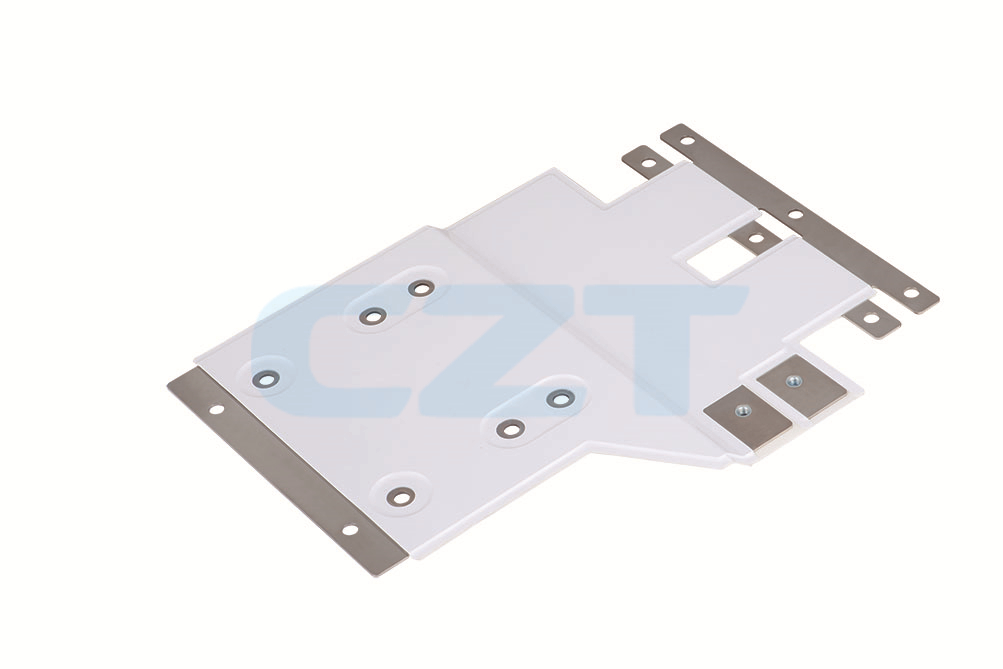
Figure 1. CZT laminated busbar example provides context for locating exposed edges and holes during dielectric-failure investigation; no failure is depicted. CZT source · Original image.
Record the test as performed
Capture the sample revision, preparation, conditioning and environment. Record the voltage waveform, ramp, duration, measured leakage and instrument trip behavior using the applicable approved test method. Identify exactly which conductors and fixtures were energized or grounded.
The test plan should come from the target product's qualification requirements and a competent laboratory. Do not select a new voltage or ramp simply to obtain a passing result. If the setup departed from the plan, document that departure and assess its effect before interpreting the specimen.
Locate the failure path
Photograph the as-found specimen and fixture. Examine exposed edges, holes, contamination and contact with nearby hardware. Keep the test leads and support locations visible in the record because fixture geometry can create an unintended short path.
Distinguish observations from hypotheses. A dark mark may locate an event without proving whether contamination, material damage or insufficient separation initiated it. If destructive examination is needed, agree the sequence so that opening one region does not remove evidence elsewhere.
Use a hypothesis checklist
| Observation or concern | Evidence to collect |
|---|---|
| Surface track | Contamination, humidity and surface geometry |
| Local puncture | Insulation thickness, section and material condition |
| Hole-edge event | Burr, coverage and hardware relationship |
| Fixture-related flashover | Lead routing and support separation |
| Inconsistent failures | Repeatability, preparation and sample history |
Include an unaffected control sample when useful, but do not repeatedly stress the only failed specimen before the evidence has been documented.

Figure 2. CZT coated busbar examples illustrate finished surface and terminal boundaries that must be documented before interpreting a dielectric-test event. CZT source · Original image.
Match the correction to the mechanism
A material substitution may not solve a fixture flashover. Increasing insulation thickness may leave an exposed conductive edge unchanged. Select a correction only after the available evidence supports the relevant path, then repeat the required checks using the controlled setup.
CZT's busbar and energy-storage family is relevant for requesting drawings of laminated, flexible or coated constructions. A catalog label does not demonstrate that any particular construction passes a dielectric requirement. The proof must identify the actual specimen and test conditions.
Check the fixture for evidence of the same event before replacing it. A useful investigation preserves both specimen and setup observations, making it easier to distinguish an assembly defect from a test connection or support that created a different electrical path.
The final report should state the initial failure, observations, supported mechanism, corrective revision and verification result. If the mechanism remains uncertain, say which further examination is required. Preserve raw leakage records and test photographs with the drawing revision so that future changes are evaluated against a real baseline rather than a simple pass/fail entry.
Connect this review to CZT product information
Start with the relevant CZT product family and provide the original interface reference or controlled drawing. Ask which configurations and supporting documents are available for the task described here. Confirm the mating arrangement, required features and project conditions before choosing an orderable part.
Browse the relevant product family · View catalog resources
Discuss a drawing, sample or quotation
Share the part or family reference, current drawing revision, operating conditions and quantities. Include the specific checks described in this article so the inquiry identifies both the component and the evidence needed for your decision. Confirm sample availability and the proposed scope with the supplier.
Request a technical review or quotation
For broader context, read the related selection guide.