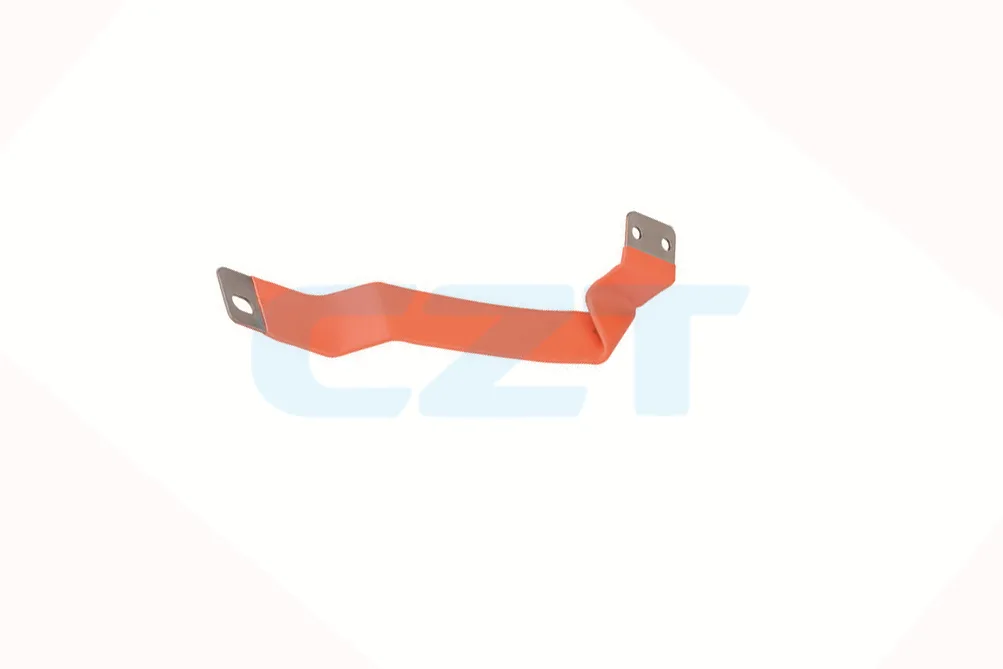
A repeated-displacement test for a flexible busbar must reproduce the movement the assembly is expected to experience. Define travel, direction, rotation and restraint before choosing a cycle count. A sample bent freely by hand does not establish endurance when installed between offset terminals inside a cabinet.

Figure 1. CZT flexible busbar example. Mark the free section, terminal restraint and starting shape before defining a repeated-displacement fixture. CZT source · Original image.
Translate the application into a motion description
Describe the relative motion between the two connection points. Separate axial travel, lateral offset and angular movement, and state whether they occur together. Record the initial installed shape, including any permanent offset already imposed during assembly.
Identify whether the movement comes from thermal expansion, equipment motion, transport or maintenance. These may require different validation cases. Combining them into an arbitrary large motion can create a dramatic test that represents none of the actual uses.
Make the fixture representative
Show the clamped lengths, terminal faces, fastening stack and free flexible region. A clamp placed closer to the bend changes the sample's behavior. Include adjacent hardware or insulation where it affects movement or contact.
CZT's energy-storage busbar family lists an Energy Storage Flexible Busbar. Its catalog identity indicates a product discussion area; it does not establish an allowable stroke, bending radius or endurance value. Those need the specific construction and validation evidence.
A useful test-plan checklist
| Test-plan field | Definition to establish |
|---|---|
| Starting geometry | Installed shape and initial offset |
| Motion | Travel vector, angle and sequence |
| Restraint | Clamp positions, terminal stack and fixture stiffness |
| Timing | Speed, dwell and any thermal conditioning |
| Monitoring | Resistance, visible damage and relevant temperatures |
| Completion | Agreed cycle count and failure or stop criteria |
Set the completion rules before the run. Continuing after a defined failure may be useful for analysis, but it should not erase the point where the acceptance requirement was first exceeded.

Figure 2. CZT formed flexible connections show alternative installed shapes; endurance evidence must describe the actual displacement direction and fixture used. CZT source · Original image.
Track change, not just survival
Record baseline resistance and specimen photographs using consistent reference points. At planned intervals, inspect the flexible region and connections. If electrical loading is part of the test, define its timing and conditions separately from the mechanical motion.
A specimen that completes the cycles can still show an unacceptable change in contact condition or resistance. Conversely, a cosmetic change may require investigation without necessarily proving loss of function. Define these distinctions with the application owner rather than making them after inspecting the results.
Photograph the sample at both motion extremes and at its starting position. These views can expose unintended twisting or fixture contact that a recorded actuator stroke does not describe, especially when the flexible section moves out of the nominal drawing plane.
The report should identify the tested displacement envelope and assembly condition explicitly. Do not translate one-axis endurance into a general guarantee for all movement directions. Retain a representative tested sample and fixture photographs so that a later design revision can be compared with the actual validated structure, not with a simplified drawing that omits its restraints.
Connect this review to CZT product information
Catalog references to discuss are listed below. Use the identifiers to request the current drawing and confirm the configuration required by your application.
| Catalog reference | Product information | Drawing record | Reference inquiry |
|---|---|---|---|
| Energy-storage flexible-connection catalog record | Energy-storage flexible-connection catalog record | Request the current drawing | Ask about this reference |
These entries identify catalog families. Their listing does not establish a numerical rating, finished-part tolerance or test approval; obtain that evidence for the requested revision.
Browse the relevant product family · View catalog resources
Discuss a drawing, sample or quotation
Share the part or family reference, current drawing revision, operating conditions and quantities. Include the specific checks described in this article so the inquiry identifies both the component and the evidence needed for your decision. Confirm sample availability and the proposed scope with the supplier.
Request a technical review or quotation
For broader context, read the related selection guide.