The cable connecting solar panels to inverters and combiner boxes is exposed to conditions that would destroy standard electrical wire within months: continuous UV radiation, temperature extremes from -40°C to +90°C, outdoor moisture, and in some installations, direct burial or roof contact. PV wire and solar cable are the two main cable types designed for these conditions — but they are not the same product, and using the wrong one can create safety hazards and void equipment warranties.

What Is PV Wire?
PV wire is a North American designation defined by UL 4703 (Photovoltaic Wire). It is the standard cable type for solar PV systems in the United States and Canada.
PV Wire Construction
- Conductor: Stranded copper (tinned or bare), typically 10 AWG to 2 AWG for residential/commercial systems
- Insulation: Cross-linked polyethylene (XLPE) or ethylene propylene rubber (EPR)
- Jacket: Sunlight-resistant, moisture-resistant outer jacket
- Color: Black (negative) and red (positive) are standard; some manufacturers use white for positive
PV Wire Ratings
| Parameter | Value |
|---|---|
| Voltage rating | 600V or 1,000V DC (UL 4703) |
| Temperature rating | 90°C (wet or dry), 150°C (dry only for some types) |
| Sunlight resistance | Required (UL 4703) |
| Flame resistance | Required |
| Wet location rating | Yes |
| Direct burial | Not rated (requires conduit) |
| Standard | UL 4703 |
PV wire is rated for 600V or 1,000V DC depending on the specific product. For systems with string voltages above 600V (common in commercial and utility-scale installations), 1,000V-rated PV wire is required.
What Is USE-2 Wire?
USE-2 (Underground Service Entrance, 2) is another cable type commonly used in North American solar installations. USE-2 is defined by UL 854 and is rated for underground use.
USE-2 Ratings
| Parameter | Value |
|---|---|
| Voltage rating | 600V |
| Temperature rating | 90°C (wet or dry) |
| Sunlight resistance | Yes (USE-2 is sunlight-resistant) |
| Direct burial | Yes (rated for direct burial) |
| Standard | UL 854 |
USE-2 is limited to 600V, making it unsuitable for systems with string voltages above 600V. It is commonly used for the DC home run cable from the combiner box to the inverter, where it may be run underground.
What Is Solar Cable (PV1-F)?
PV1-F is the European standard for solar cable, defined by EN 50618 (formerly HD 605). It is the equivalent of PV wire for European and international markets.
PV1-F Construction
- Conductor: Fine-stranded tinned copper (more flexible than PV wire)
- Insulation: XLPE (cross-linked polyethylene)
- Jacket: XLPE or EVA (ethylene vinyl acetate), halogen-free
- Color: Black (negative) and red (positive)
PV1-F Ratings
| Parameter | Value |
|---|---|
| Voltage rating | 1,500V DC (EN 50618) |
| Temperature rating | -40°C to +90°C (continuous), +120°C (short-term) |
| Sunlight resistance | Required (UV stabilized) |
| Flame resistance | Required (halogen-free) |
| Wet location rating | Yes |
| Standard | EN 50618 / IEC 62930 |
PV1-F is rated for 1,500V DC, making it suitable for utility-scale systems with high string voltages. The halogen-free construction is required in many European markets for fire safety reasons.
PV Wire vs Solar Cable (PV1-F): Key Differences
| Parameter | PV Wire (UL 4703) | Solar Cable (PV1-F / EN 50618) |
|---|---|---|
| Standard | UL 4703 (North America) | EN 50618 / IEC 62930 (Europe/International) |
| Max voltage | 600V or 1,000V DC | 1,500V DC |
| Temperature range | -40°C to +90°C | -40°C to +90°C |
| Conductor | Stranded copper | Fine-stranded tinned copper |
| Flexibility | Moderate | High (fine-stranded) |
| Halogen-free | Not required | Required |
| Direct burial | USE-2 only | Not standard (requires conduit) |
| Typical market | North America | Europe, Australia, Asia, international |
The most significant difference is the voltage rating: PV1-F supports 1,500V DC, while standard PV wire is limited to 1,000V. For utility-scale systems designed for 1,500V DC operation, PV1-F (or 1,500V-rated PV wire) is required.
Choosing the Right Cable for Your System
Residential Rooftop (North America)
For a typical residential system with string voltages below 600V:
- PV wire (UL 4703, 600V) for panel-to-panel and panel-to-combiner runs
- USE-2 for underground runs from combiner to inverter
For systems with string voltages 600–1,000V:
- PV wire (UL 4703, 1,000V) throughout
Commercial/Utility (North America)
For systems with string voltages up to 1,000V:
- PV wire (UL 4703, 1,000V) for all DC wiring
For 1,500V DC systems:
- 1,500V-rated PV wire (UL 4703 with 1,500V rating) or PV1-F
European and Australian Systems
- PV1-F (EN 50618) is the standard choice
- Available in 1,000V and 1,500V ratings
- Halogen-free construction required in most markets
International/Export Systems
- PV1-F or IEC 62930-compliant cable for international projects
- Verify local code requirements for the installation country
Cable Sizing
Solar cable must be sized for:
Current capacity: The cable must carry the maximum string current (Isc) continuously without exceeding its temperature rating. Use the manufacturer's current capacity tables, derated for installation conditions (bundled cables, high ambient temperature, direct sun exposure).
Voltage drop: The DC voltage drop from the panels to the inverter should be < 1% for optimal system performance. Calculate voltage drop using: ΔV = 2 × L × I × R/A, where L is the one-way cable length, I is the current, R is the resistivity of copper (0.0175 Ω·mm²/m), and A is the cable cross-section.
Short-circuit protection: The cable must be protected by fuses or circuit breakers rated for the maximum fault current.
Common cable cross-sections for solar applications:
- 4mm² (12 AWG): Standard for panel-to-panel connections in residential systems
- 6mm² (10 AWG): For longer runs or higher-current strings
- 10mm² (8 AWG): For home run cables from combiner to inverter
- 16–35mm²: For large commercial systems with high combined currents
MC4 Connector Compatibility
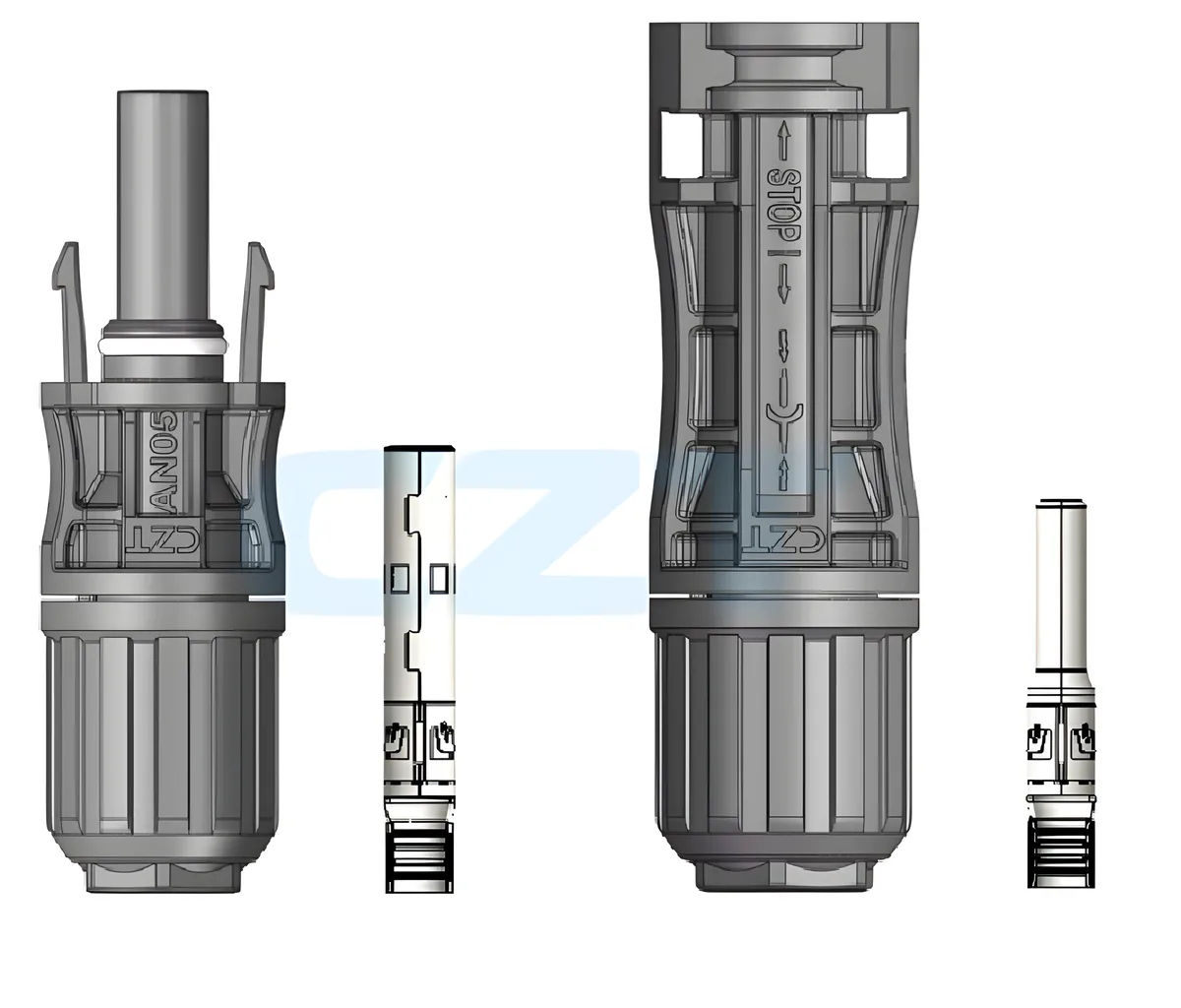
Solar cables must be compatible with the MC4 connectors used in the system. MC4 connectors are available for 2.5mm², 4mm², and 6mm² cable. Using a cable cross-section outside the connector's specified range results in a poor crimp and potential connector failure.
Always verify that the cable outer diameter is within the MC4 connector's specified range for the cable seal to achieve its IP67 rating.
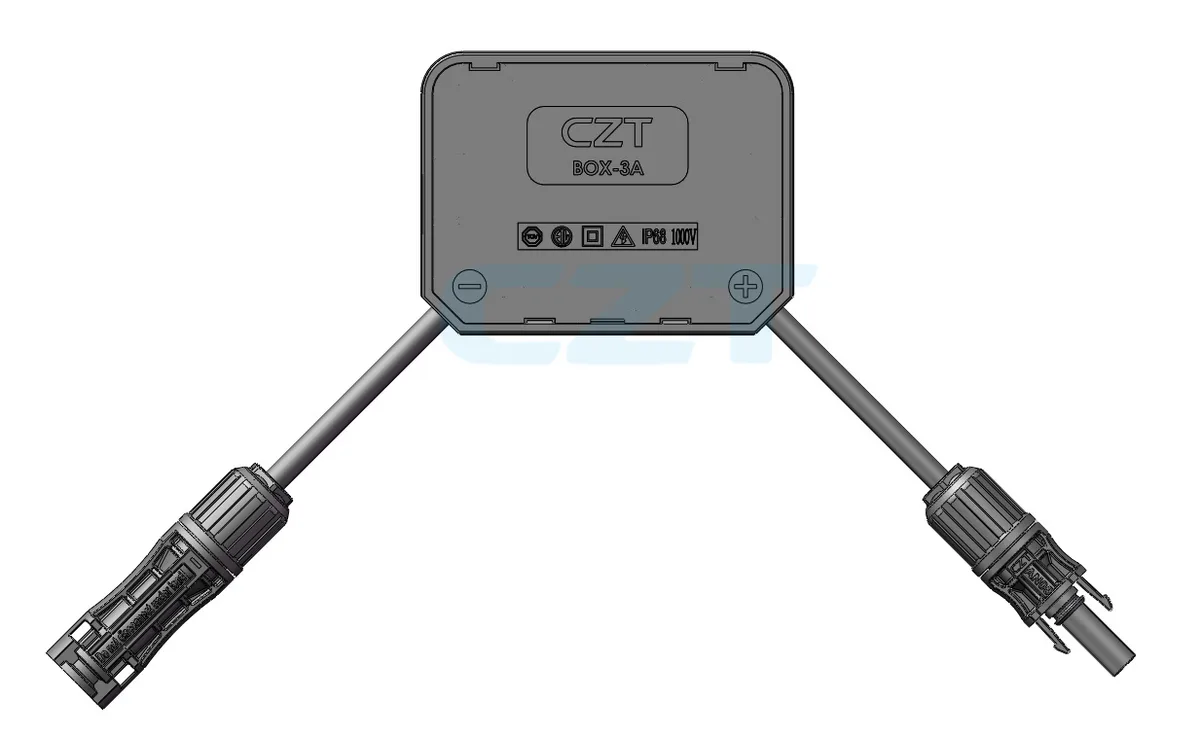
CZT's solar PV connector range includes MC4 connectors sized for 2.5mm², 4mm², and 6mm² solar cable, with IEC 62852 certification for 1,000V and 1,500V systems.
Summary
| Cable Type | Standard | Max Voltage | Market | Best For |
|---|---|---|---|---|
| PV Wire 600V | UL 4703 | 600V DC | North America | Residential, low-voltage strings |
| PV Wire 1,000V | UL 4703 | 1,000V DC | North America | Commercial, high-voltage strings |
| USE-2 | UL 854 | 600V DC | North America | Underground runs |
| PV1-F 1,000V | EN 50618 | 1,000V DC | Europe/International | Standard European residential/commercial |
| PV1-F 1,500V | EN 50618 | 1,500V DC | Europe/International | Utility-scale, 1,500V systems |
Use the cable standard appropriate for your market (UL 4703 in North America, EN 50618 internationally), sized for the maximum string voltage and current, with MC4 connectors matched to the cable cross-section.