How you wire solar panels together determines the voltage and current your system produces — and whether your inverter or charge controller can accept it. Series wiring increases voltage while keeping current constant. Parallel wiring increases current while keeping voltage constant. Getting this wrong means your system either won't work or won't perform at its rated capacity.
This guide explains the electrical principles behind series and parallel solar panel wiring, how to calculate string voltages and currents, and how to choose the right configuration for your system.
The Basics: Voltage and Current in Solar Panels
Every solar panel has two key electrical ratings:
- Voc (Open Circuit Voltage): The voltage across the panel terminals when no current is flowing. This is the maximum voltage the panel produces.
- Isc (Short Circuit Current): The current flowing when the terminals are shorted. This is the maximum current the panel produces.
- Vmp (Maximum Power Voltage): The voltage at which the panel produces maximum power.
- Imp (Maximum Power Current): The current at which the panel produces maximum power.
A typical 400W residential panel might have: Voc = 49V, Isc = 10.5A, Vmp = 41V, Imp = 9.8A.
Series Wiring: Adding Voltages
When solar panels are wired in series, the positive terminal of one panel connects to the negative terminal of the next. The result:
- Voltage adds: Total string voltage = sum of individual panel voltages
- Current stays the same: String current = current of one panel
Example: 10 panels × 49V Voc = 490V string Voc. Current remains 10.5A Isc.

Why Series Wiring Is Used
Inverter compatibility: Most string inverters require input voltages of 200–1,000V DC (or up to 1,500V for utility-scale systems). A single 400W panel at 49V is far below this range. Wiring panels in series raises the string voltage to the inverter's operating window.
Reduced current and cable losses: Higher voltage means lower current for the same power (P = V × I). Lower current means smaller cable cross-sections and lower resistive losses. A 10-panel string at 490V and 10A requires much smaller cable than the same panels at 49V and 100A.
Longer cable runs: The lower current in a series string allows longer cable runs without excessive voltage drop.
Series Wiring Limitations
Shading sensitivity: In a series string, the weakest panel limits the entire string. If one panel is shaded and produces only 50% of its rated current, the entire string current drops to 50%. This is the most significant disadvantage of series wiring.
Maximum voltage limits: The string voltage must not exceed the inverter's maximum input voltage or the cable/connector voltage rating. At low temperatures, Voc increases — always calculate the maximum string voltage at the minimum expected temperature.
Voltage temperature coefficient: Solar panel voltage increases as temperature decreases. The temperature coefficient of Voc (typically -0.3% to -0.4%/°C) must be applied when calculating maximum string voltage for cold climates.
Parallel Wiring: Adding Currents
When solar panels are wired in parallel, all positive terminals connect together and all negative terminals connect together. The result:
- Current adds: Total current = sum of individual panel currents
- Voltage stays the same: Array voltage = voltage of one panel
Example: 10 panels × 10.5A Isc = 105A total Isc. Voltage remains 49V Voc.
Why Parallel Wiring Is Used
Low-voltage systems: Off-grid systems with 12V, 24V, or 48V battery banks require low array voltages. Parallel wiring keeps the voltage at the panel's native voltage while increasing current to charge the battery bank.
Shading tolerance: In a parallel configuration, a shaded panel only reduces the total current by its proportional contribution. The other panels continue operating at full voltage and current.
Charge controller compatibility: MPPT charge controllers for off-grid systems typically have lower voltage limits (150V or 250V) than grid-tie inverters. Parallel wiring keeps the array voltage within these limits.
Parallel Wiring Limitations
High current: Parallel wiring produces high currents that require larger cable cross-sections and higher-rated connectors and fuses.
Combiner boxes required: Large parallel arrays require combiner boxes with fuses or circuit breakers on each parallel branch to protect against reverse current flow.
Cable losses: High current means higher resistive losses in cables. Parallel arrays require careful cable sizing to minimize voltage drop.
Series-Parallel (Hybrid) Wiring
Most real-world solar installations use a combination of series and parallel wiring:
- Wire panels in series to form strings (raising voltage to the inverter's operating range)
- Wire multiple strings in parallel to increase total power output
Example: A 20-panel system might be wired as 2 strings of 10 panels each, with the two strings connected in parallel at the inverter input. Each string produces 490V at 10A; the parallel combination produces 490V at 20A = 9.8 kW.

String Sizing for Grid-Tie Inverters
When sizing strings for a grid-tie inverter, the key constraints are:
Maximum input voltage: The string Voc at minimum temperature must not exceed the inverter's maximum input voltage. Use the temperature coefficient to calculate Voc at the coldest expected temperature.
MPPT voltage range: The string Vmp at maximum temperature must remain within the inverter's MPPT (Maximum Power Point Tracking) voltage range. At high temperatures, Vmp decreases.
Maximum input current: The total parallel current must not exceed the inverter's maximum input current per MPPT input.
Minimum string voltage: The string Vmp at maximum temperature must exceed the inverter's minimum MPPT voltage to ensure the inverter can track the maximum power point.
Most inverter manufacturers provide string sizing calculators or software tools that automate these calculations.
MC4 Connectors for Series and Parallel Wiring
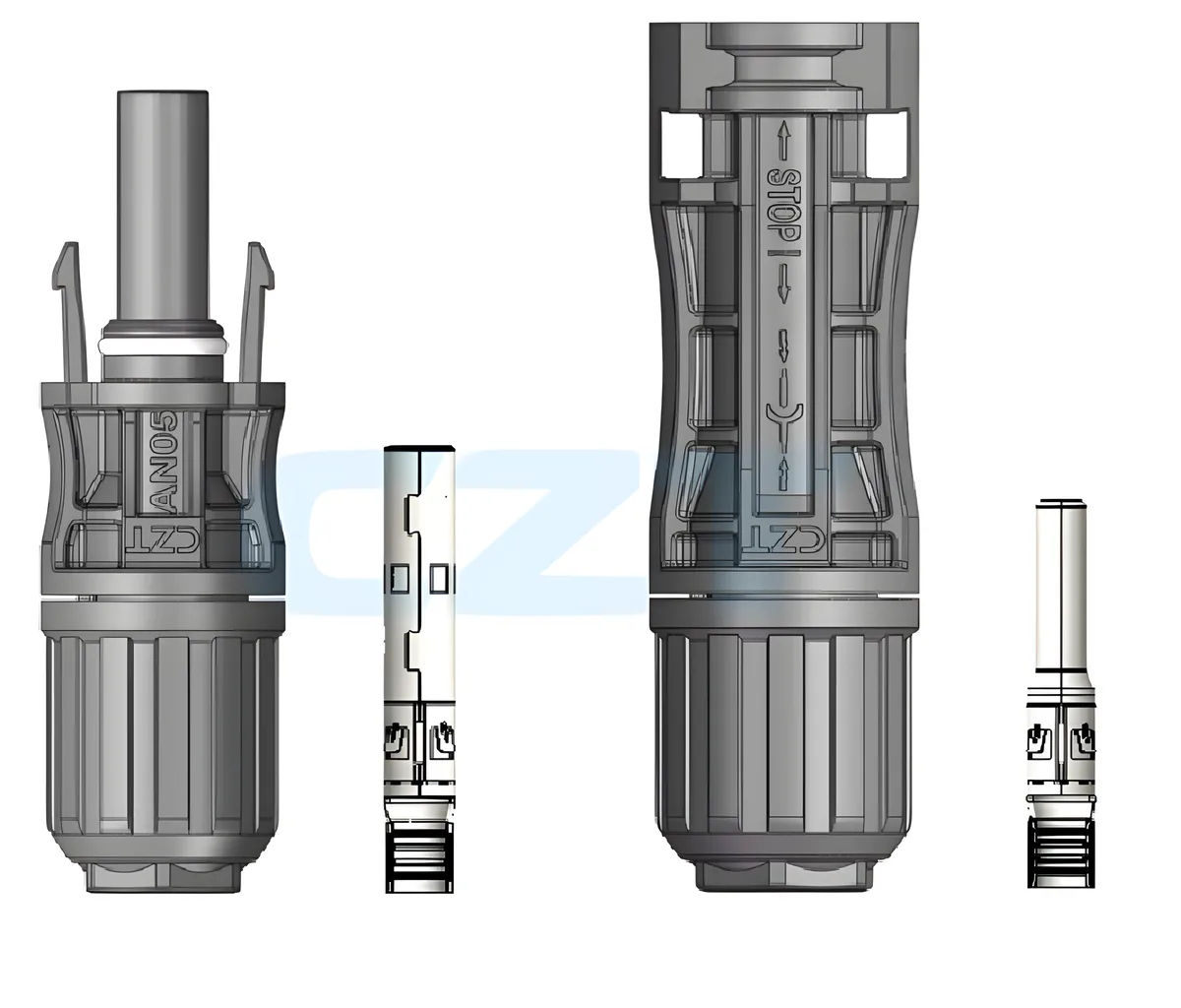
MC4 connectors are the standard for solar panel string wiring. Each panel comes with MC4 connectors on its output leads. Series wiring is achieved by connecting the male MC4 of one panel to the female MC4 of the next.
For parallel wiring, MC4 branch connectors (T-connectors or Y-connectors) combine multiple strings. A 2-to-1 branch connector combines two parallel strings into a single cable run to the inverter or combiner box.
Key MC4 connector considerations for series-parallel arrays:
- Voltage rating: Verify MC4 connectors are rated for the maximum string voltage (1,000V or 1,500V DC)
- Current rating: Branch connectors must be rated for the combined parallel current
- Consistency: Use the same manufacturer's MC4 connectors throughout to ensure proper sealing and contact
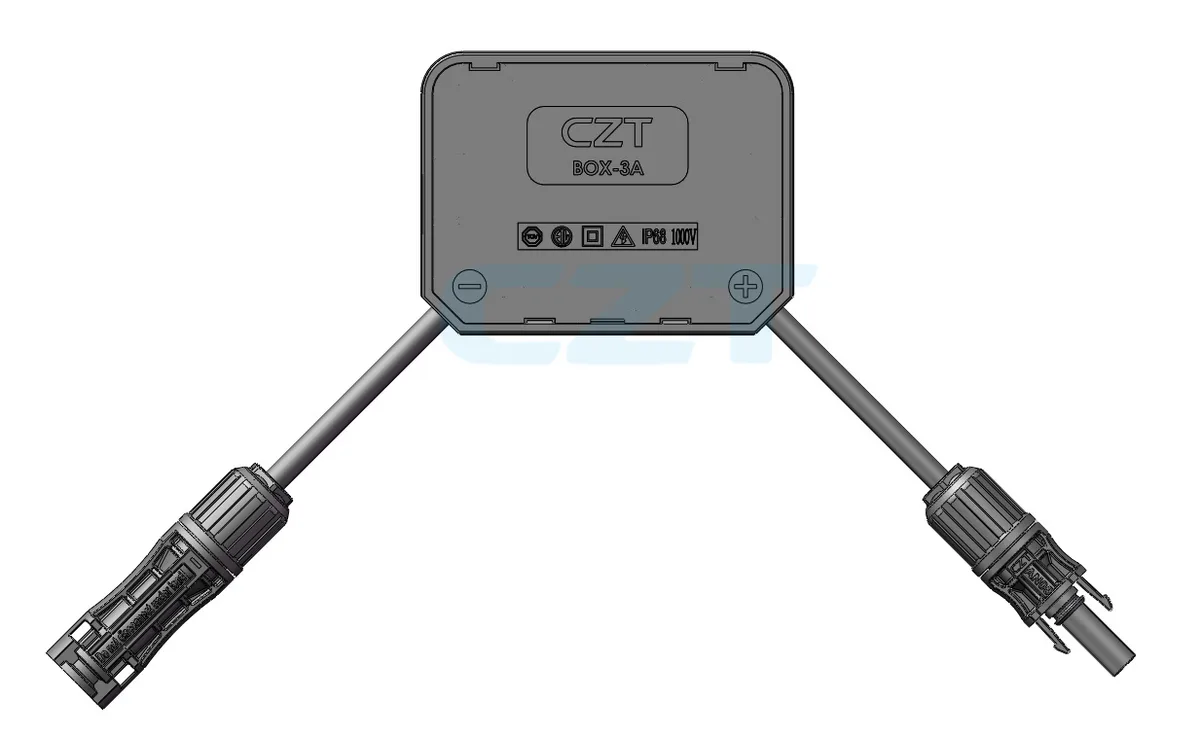
CZT's solar PV connector range includes MC4 connectors, MC4 branch connectors, and MC4 extension cables rated for 1,000V and 1,500V DC systems.
Practical Wiring Guidelines
Always calculate maximum string voltage using the temperature coefficient and minimum expected temperature before finalizing string length.
Match panel specifications within a string: Panels in series must have the same current rating (Isc). Mixing panels with different Isc values in a series string causes the lower-current panel to limit the entire string.
Use appropriate cable cross-sections: Solar cable (PV1-F or USE-2) is rated for outdoor UV exposure. Size the cable for the maximum current with acceptable voltage drop (typically < 1% for DC runs).
Install string fuses or circuit breakers when wiring more than two strings in parallel. This protects against reverse current flow if one string fails.
Label all strings at the combiner box or inverter for easier troubleshooting.
Summary
| Configuration | Voltage | Current | Best For |
|---|---|---|---|
| Series | Adds | Same | Grid-tie inverters, long cable runs |
| Parallel | Same | Adds | Off-grid battery systems, shading tolerance |
| Series-Parallel | Controlled | Controlled | Most grid-tie systems |
The right wiring configuration depends on your inverter or charge controller's input requirements. For grid-tie systems, series strings sized to the inverter's MPPT voltage range are standard. For off-grid battery systems, parallel or series-parallel configurations sized to the battery bank voltage are typical.
Always verify string voltage calculations before installation, and use MC4 connectors rated for your system's maximum voltage and current.