Choose an RJ45 plug for the actual conductor construction, not only its nominal wire size or the word “Ethernet.” Solid and stranded conductors can interact differently with a plug's contact-termination geometry, and the acceptable combination must come from the component's documented application scope.
Review the relevant drawings in the CZT RJ45 and Ethernet family, then pair an identified plug with an identified cable. A successful temporary connection is not sufficient evidence for an unreviewed production combination.
Describe the conductor fully
For solid wire, record the conductor and insulation dimensions. For stranded wire, record the construction and the dimensions relevant to the termination. Include jacket, separator and shield information where those affect assembly.
Preserve the cable manufacturer's terminology and units. Converting a conductor designation into a nominal size should not erase the construction details that the plug application specification uses.

Figure 1. Official QWY-1013-10 8P8C plug photograph, showing the housing, latch and contact region. CZT source · Original image.
Review the contact mechanism
Look for an explicit statement of the cable constructions supported by the plug and its termination method. Do not infer solid-versus-stranded suitability from contact color, a photograph or a count of visible contact points.
Ask how the specified tool positions and drives the contact. The approved plug, cable and tool form a combination. Changing one can alter the resulting engagement even when the other two remain unchanged.
Build a termination comparison sheet
| Comparison field | Solid candidate combination | Stranded candidate combination |
|---|---|---|
| Cable identity | Exact construction and dimensions | Exact construction and dimensions |
| Plug scope | Documented compatible application | Documented compatible application |
| Tooling | Tool and setting reference | Tool and setting reference |
| Inspection | Defined contact-engagement checks | Defined contact-engagement checks |
| Mechanical evidence | Retention and flex requirements | Retention and flex requirements |
| Electrical evidence | Applicable finished-assembly checks | Applicable finished-assembly checks |
A blank compatibility cell means the combination needs clarification. It should not be filled with an assumption that a plug marketed broadly for networking handles every conductor.
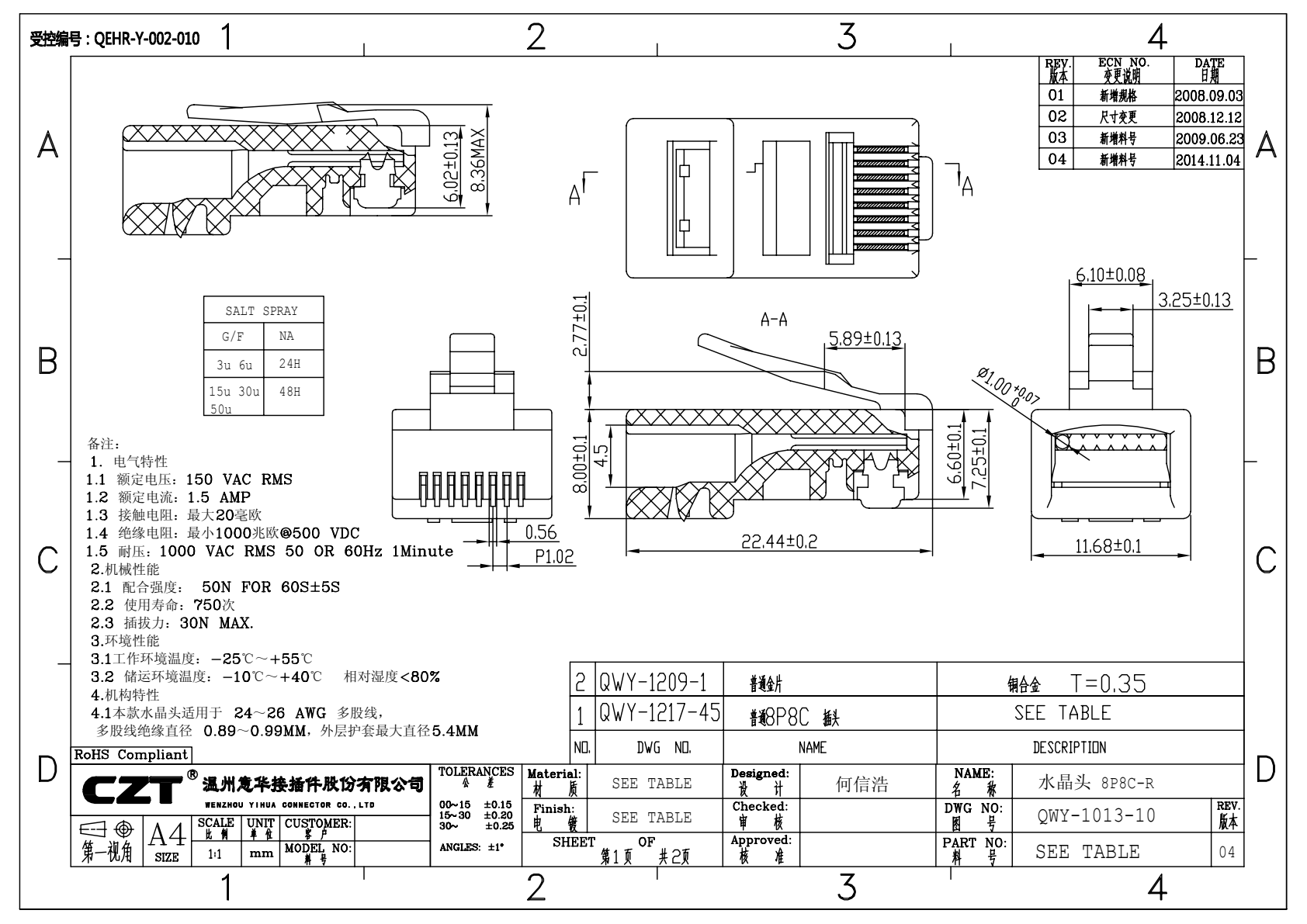
Figure 2. QWY-1013-10 manufacturer drawing with plug geometry and termination-section views. CZT source · Original PDF, page 1.
Evaluate the finished termination
Use the prescribed preparation and tooling. Inspect conductor positioning, contact engagement and jacket restraint. Apply the appropriate electrical and mechanical checks to the finished assembly, preserving the sample identities and process settings.
For a hypothetical comparison, both cable constructions might pass a basic continuity check initially while one shows an unsuitable termination under the agreed inspection method. The initial continuity result does not override that finding.
Keep approvals combination-specific
Release the cable, plug, tool and process together. If a supplier changes the conductor construction or the plug contact design, review the affected combination before production use.
This creates a practical purchasing boundary and reduces avoidable arguments over whether a generic label promised compatibility. The approved evidence describes what was actually assembled and evaluated, rather than what the interface name might suggest.
Connect this review to CZT product information
Start with the relevant CZT product family and provide the original interface reference or controlled drawing. Ask which configurations and supporting documents are available for the task described here. Confirm the mating arrangement, required features and project conditions before choosing an orderable part.
Browse the relevant product family · View catalog resources
Discuss a drawing, sample or quotation
Share the part or family reference, current drawing revision, operating conditions and quantities. Include the specific checks described in this article so the inquiry identifies both the component and the evidence needed for your decision. Confirm sample availability and the proposed scope with the supplier.
Request a technical review or quotation
For broader context, read the related selection guide.