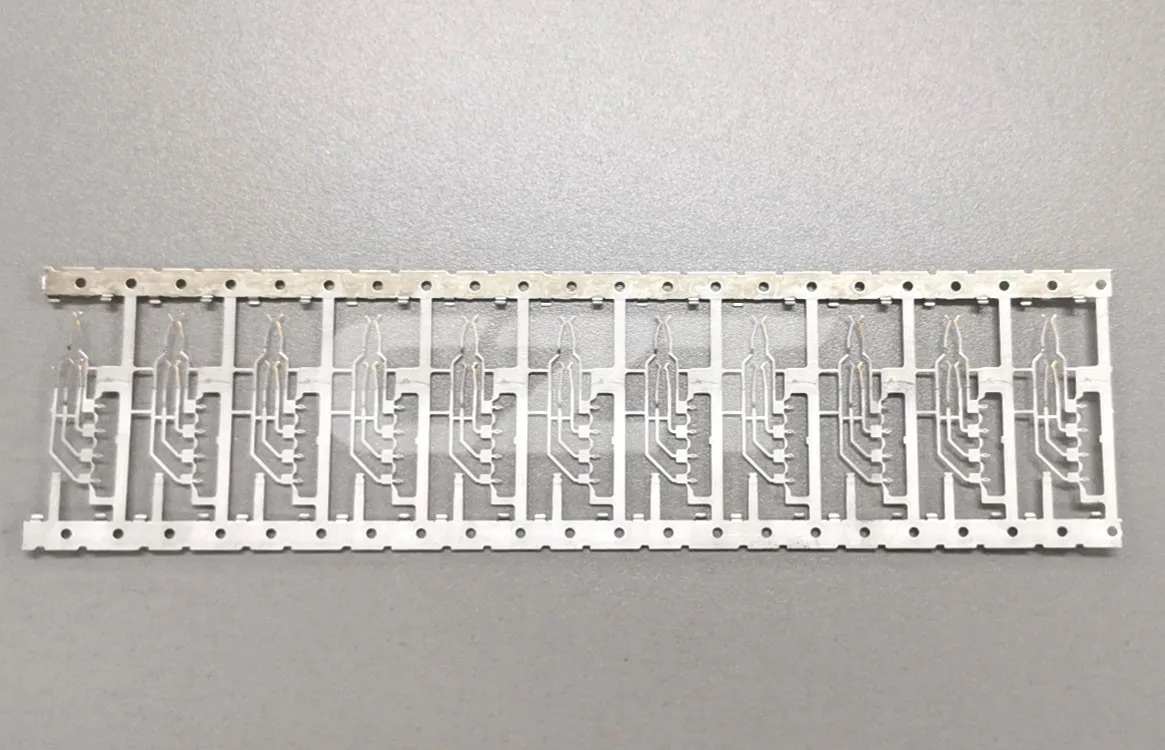
Selective plating needs a controlled boundary between differently finished regions. That boundary should be related to the functional contact zone and the manufacturing reference features, not described only as the approximate area visible on a sample photograph.
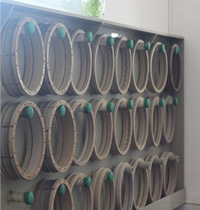
Figure 1. CZT selective-plating tooling. The official selective-plating tooling photograph connects boundary control with a real manufacturing process. CZT source · Original image.
Locate the functional zone
Show where the mating contact actually operates across its movement and dimensional tolerances. The required finish coverage should protect that functional region under the agreed conditions. A boundary placed exactly at the nominal contact point can leave too little allowance for variation in the terminal, mating part or plating process.
Also identify soldering, crimping, forming and carrier areas. A treatment that is appropriate at the separable interface may not be the intended finish for another region. The drawing should explain these distinctions without relying on color shading alone.
Make the transition measurable
| Drawing element | Question it answers |
|---|---|
| Datum or strip reference | Where does the plating location originate? |
| Required coverage | Which area must have the specified finish? |
| Transition allowance | Where may the boundary vary? |
| Exclusion zone | Which area must remain outside that finish? |
| Inspection view | How is the location judged at the relevant production stage? |
Use an acceptance definition that reflects the process. A visually diffuse transition may need a different inspection approach from a machined edge. Agree on how boundary position and thickness will be checked, especially where the measurement spot could overlap both regions.
Review forming and process sequence
If plating occurs on strip before forming, explain how the finished contact region maps back to the strip reference. A change in forming, carrier position or feed direction can affect that relationship. If a terminal is plated after forming, check access to the required zone and any fixture-contact marks.
The CZT connector electroplating family includes selective-plating references. Use the actual SFP or other terminal identifier to ask for feasibility against the marked drawing; the product label alone does not define the achievable boundary tolerance.
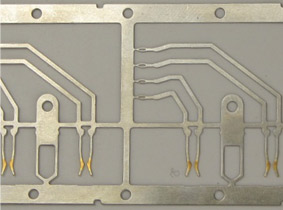
Figure 2. CZT selective-plating examples. Real selective-plating product examples illustrate location-dependent coverage; exact zones and tolerances still require the controlled drawing. CZT source · Original image.
Confirm the delivered condition
Inspect trial samples at the stage relevant to the requirement and preserve identified images or samples of the transition. Do not approve only the overall appearance while leaving the functional zone unmeasured. Where electrical or durability evaluation is required, use samples with the controlled finish boundary.
Keep the approved process reference, drawing revision and inspection method together. Revisit the boundary when contact geometry, strip layout or forming operations change. This prevents a seemingly small production adjustment from shifting the finish away from the part of the terminal where the contact system needs it.
For a proposed process adjustment, compare the new boundary on representative formed terminals rather than only on flat strip. This checks that the relationship between the production reference and the final contact position has been preserved through the complete operation sequence.
Connect this review to CZT product information
Catalog references to discuss are listed below. Use the identifiers to request the current drawing and confirm the configuration required by your application.
| Catalog reference | Product information | Drawing record | Reference inquiry |
|---|---|---|---|
| SFP 2xN selective spot-plating catalog record | SFP 2xN selective spot-plating catalog record | Request the current drawing | Ask about this reference |
These entries identify catalog families. Their listing does not establish a numerical rating, finished-part tolerance or test approval; obtain that evidence for the requested revision.
Browse the relevant product family · View catalog resources
Discuss a drawing, sample or quotation
Share the part or family reference, current drawing revision, operating conditions and quantities. Include the specific checks described in this article so the inquiry identifies both the component and the evidence needed for your decision. Confirm sample availability and the proposed scope with the supplier.