Every data center decision eventually comes back to cabling. The physical layer determines what speeds you can reach, how far signals travel, and how much you spend per port. Get it wrong and you face forklift upgrades years ahead of schedule.
The fiber vs copper debate is not really a debate at all. Modern data centers use both. The real question is where each technology fits in your architecture, and how to allocate budget between them. This guide breaks down the technical differences, maps each cable type to its ideal use case, and explains why most facilities end up with a hybrid approach.

Data Center Cabling Fiber vs Copper: Quick Answer
If you need the short answer, copper is usually best for very short server-to-switch runs, PoE devices, and management networks, while fiber is the better choice for backbone links, spine-leaf interconnects, longer distances, and higher-speed upgrades. Most modern facilities end up with both.
| Decision factor | Copper in the data center | Fiber in the data center | Better fit when |
|---|---|---|---|
| Practical short-reach use | Cat6a server-to-ToR, Cat8 short switch links | Less common for the shortest server patching | Lowest per-port cost matters |
| Distance | Cat6a supports 10G to 100 m; Cat8 supports 25/40G to 30 m | OM4 reaches far beyond copper inside the hall; OS2 supports campus and inter-building links | The run is long or may need future expansion |
| Latency and power | 10GBASE-T adds measurable microseconds and typically draws 2 to 5 W per port | SFP+ fiber links typically consume around 1 W per port | Low latency and lower cooling load matter |
| Density and cable weight | Thicker bundles, more tray fill | Much higher port density with smaller, lighter trunks | Rack density and pathway capacity are constrained |
| Power delivery | Supports PoE | Does not deliver electrical power | You need power and data on the same cable |
For most enterprise and colocation builds, the clean design rule is simple: use copper at the access edge, use fiber in the aggregation and backbone, and avoid forcing one medium to do every job.
Copper Cabling in Modern Data Centers
Copper cabling has been the backbone of local area networking for decades. In data centers, it remains the dominant choice for short-distance connections between servers and top-of-rack (ToR) switches.
Copper Cable Categories Used in Data Centers
Not all copper is created equal. The category rating determines bandwidth capacity and maximum supported data rate.
Cat6 supports 10 Gbps at distances up to 55 meters and operates at frequencies up to 250 MHz. It is still found in older facilities but is rarely specified for new builds.
Cat6a is the current workhorse. It supports 10GBASE-T at the full 100-meter channel length and operates at 500 MHz. The "a" stands for augmented, referring to improved alien crosstalk performance. Most new data center copper runs use Cat6a.
Cat8 targets 25GBASE-T and 40GBASE-T applications at distances up to 30 meters. It operates at 2000 MHz and is designed specifically for data center switch-to-switch and switch-to-server connections. Cat8 uses shielded construction (S/FTP) to hit these performance targets.
| Category | Max Data Rate | Max Distance | Frequency | Shielding | Typical Use |
|---|---|---|---|---|---|
| Cat6 | 10 Gbps | 55 m (10G) / 100 m (1G) | 250 MHz | UTP or STP | Legacy installs |
| Cat6a | 10 Gbps | 100 m | 500 MHz | UTP or STP | Server-to-ToR links |
| Cat8 | 25/40 Gbps | 30 m | 2000 MHz | S/FTP | Switch-to-switch |
Copper Connectors
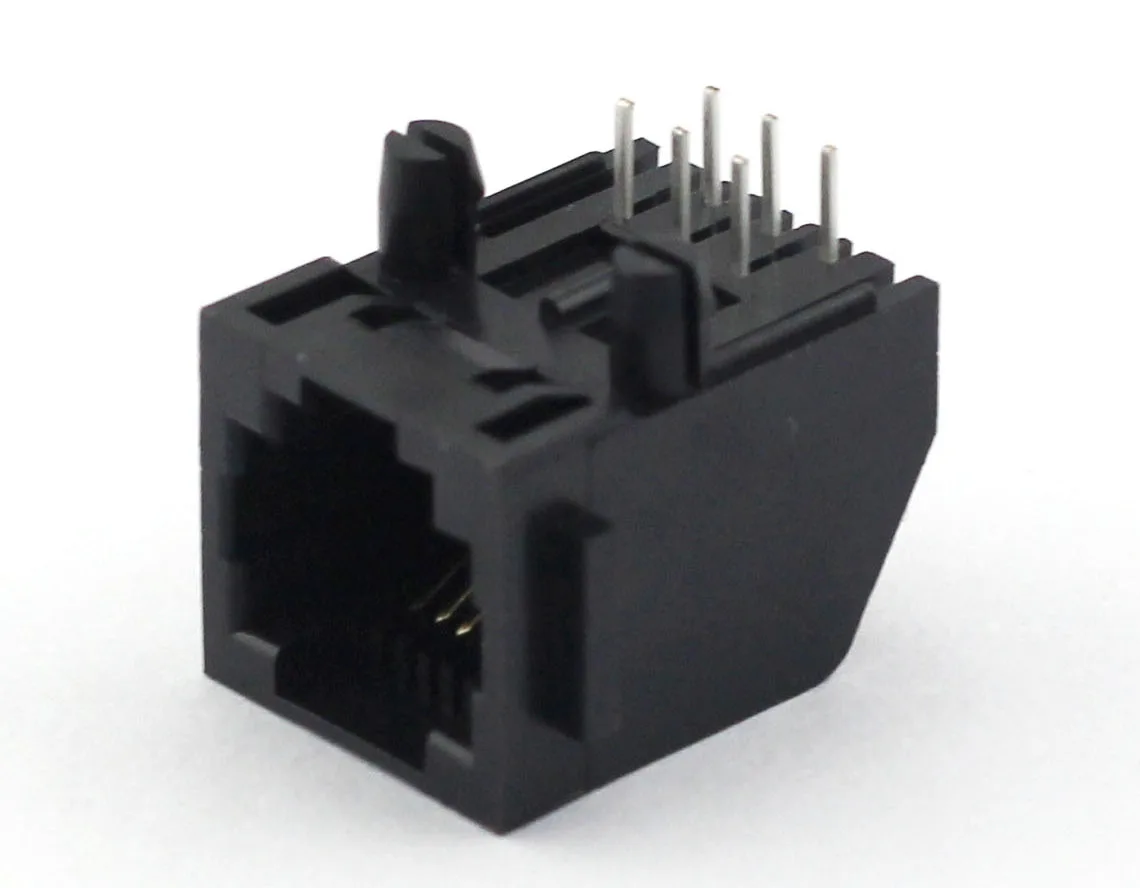
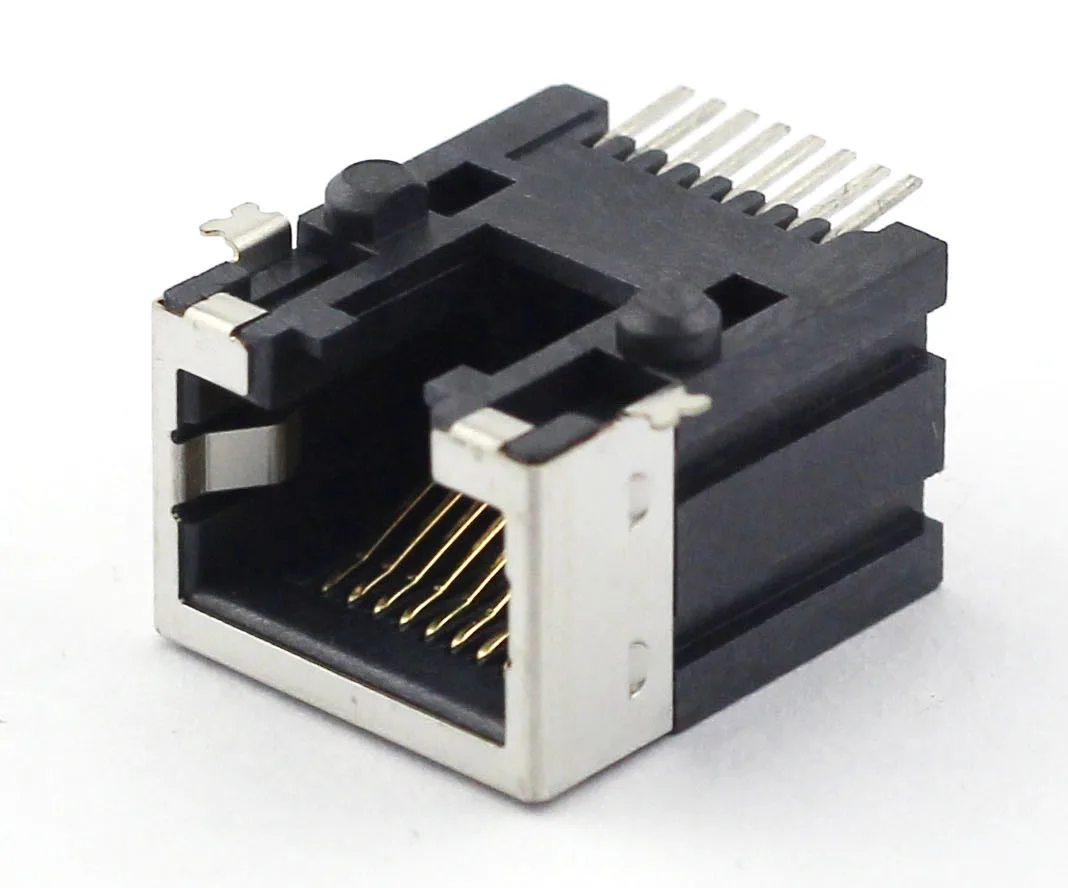
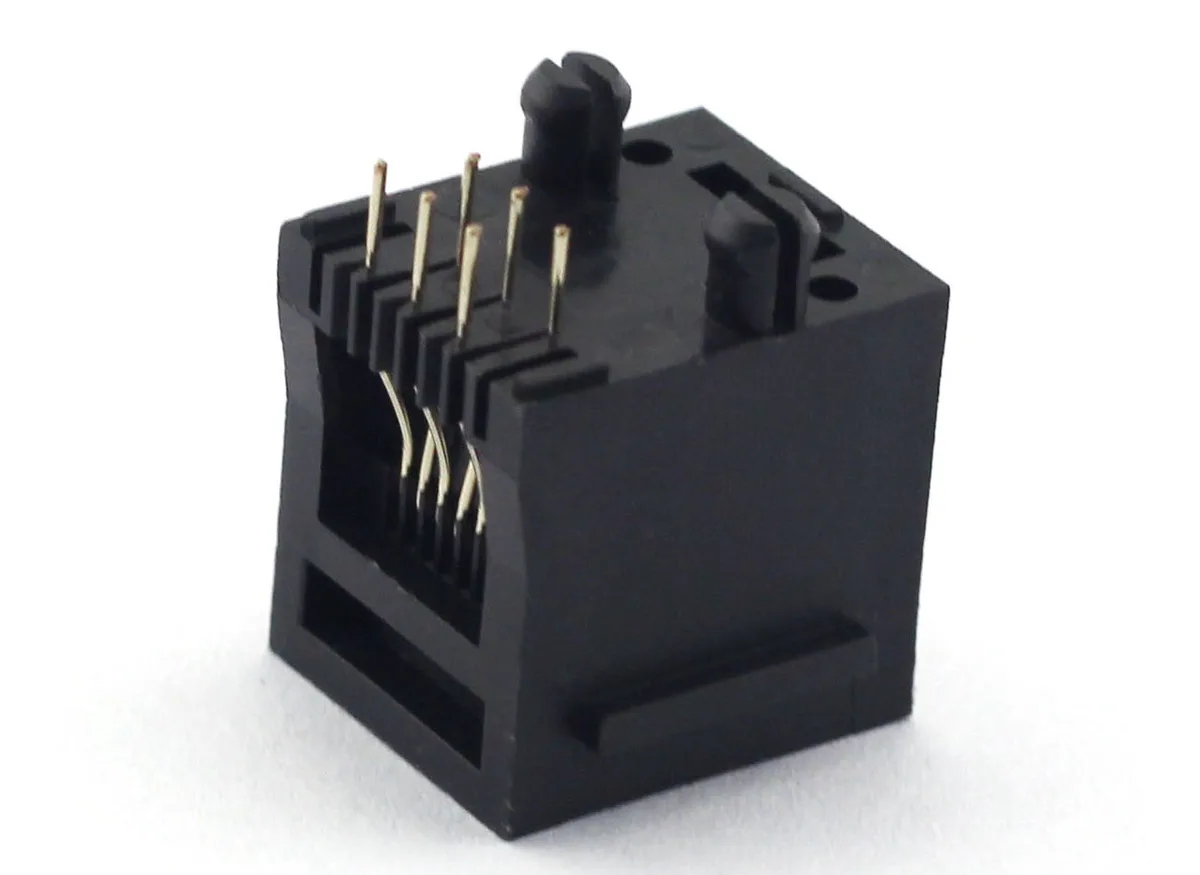
The RJ45 connector is the universal interface for copper data center cabling. Its toolless or tool-crimped termination makes field installation straightforward. Shielded RJ45 variants are required for Cat8 and recommended for Cat6a in high-density environments where alien crosstalk is a concern.
Advantages of Copper in Data Centers
Copper has several practical advantages that keep it relevant even as fiber speeds climb. The RJ45 ecosystem is mature and widely understood by installation teams. Copper patch cables cost a fraction of fiber equivalents for short runs. And copper supports Power over Ethernet (PoE), delivering both data and electrical power over a single cable — essential for IP cameras, wireless access points, and IoT sensors deployed within the facility.
Fiber Optic Cabling in Modern Data Centers
Fiber optic cabling carries data as pulses of light through glass or plastic cores. It dominates the backbone and spine-leaf interconnect layers of modern data centers, where bandwidth demands exceed what copper can deliver.
Multimode Fiber Grades
Multimode fiber uses a larger core (50 μm) that supports multiple light modes. It is the standard choice for intra-building data center links.
OM3 supports 10 Gbps at 300 meters and 40/100 Gbps (via parallel optics) at 100 meters. It uses 850 nm VCSEL transceivers and has an effective modal bandwidth of 2000 MHz·km. OM3 is adequate for smaller facilities but is being phased out of new high-speed designs.
OM4 extends 10G reach to 400 meters and 100G parallel reach to 150 meters. Its 4700 MHz·km bandwidth makes it the most widely deployed multimode grade in current data center builds.
OM5 adds support for shortwave wavelength division multiplexing (SWDM), enabling multiple wavelengths over a single fiber pair. This is relevant for 100G and 400G links that use SWDM4 transceivers. OM5 is identifiable by its lime green jacket.
For a deeper comparison of fiber types, see our guide on single-mode vs multi-mode fiber.
| Grade | Core/Cladding | Bandwidth | 10G Distance | 100G Distance | Jacket Color |
|---|---|---|---|---|---|
| OM3 | 50/125 μm | 2000 MHz·km | 300 m | 100 m | Aqua |
| OM4 | 50/125 μm | 4700 MHz·km | 400 m | 150 m | Aqua |
| OM5 | 50/125 μm | 4700 MHz·km | 300 m | 150 m (SWDM) | Lime green |
Single-Mode Fiber
OS2 single-mode fiber uses a 9 μm core and supports distances of 10 km or more at virtually any data rate currently deployed. In data centers, OS2 is used for building-to-building campus links, connections between data halls, and increasingly for intra-rack 400G/800G links where CWDM4 or DR4 transceivers are specified.
Single-mode transceivers cost more than multimode equivalents, but the fiber itself is inexpensive. For new long-reach infrastructure, single-mode often delivers better total cost of ownership.
Fiber Optic Connectors
Data center fiber relies on a small set of high-density connectors. For a comprehensive overview, see our guide on types of fiber optic connectors.
LC connectors are the standard duplex interface for SFP and SFP+ transceivers. Their small form factor enables high port density on patch panels and switches. CZT manufactures precision LC connectors with insertion loss under 0.15 dB.
MPO/MTP connectors support 8, 12, or 24 fibers in a single ferrule. They are essential for parallel optics (40G SR4, 100G SR4, 400G SR8) and for high-density trunk cabling that fans out to LC breakout cassettes at the patch panel.
SC connectors still appear in some legacy installations and carrier demarcation points but are rarely specified for new data center structured cabling.

Fiber vs Copper: Cost, Distance and Latency Comparison
The following table summarizes the key differences between fiber and copper data center cabling across the metrics that matter most to infrastructure engineers.
| Parameter | Copper (Cat6a) | Copper (Cat8) | Multimode Fiber (OM4) | Single-Mode Fiber (OS2) |
|---|---|---|---|---|
| Max Bandwidth | 10 Gbps | 25/40 Gbps | 100 Gbps (SR4) | 400 Gbps+ (DR4/FR4) |
| Max Distance | 100 m | 30 m | 400 m (10G) | 10 km+ |
| Latency | ~5 ns/m | ~5 ns/m | ~5 ns/m | ~5 ns/m |
| Cost per Port | Low | Medium | Medium | Higher (transceiver-driven) |
| Cable Cost per Meter | Low | Medium | Medium | Low |
| Power Consumption | Higher (10GBASE-T ~2-5 W) | Higher | Lower (~1 W for SFP+) | Lower |
| EMI Immunity | Susceptible (UTP) | Better (shielded) | Immune | Immune |
| Cable Weight | Heavier | Heavier | Much lighter | Much lighter |
| Cable Diameter | Larger | Larger | Smaller | Smallest |
| PoE Support | Yes (up to 90 W, Type 4) | Yes | No | No |
| Bend Radius | Flexible | Less flexible (shielded) | Moderate | Moderate |
| Termination Skill | Standard | Specialized | Specialized | Specialized |
A few points deserve emphasis. Latency through the cable itself is nearly identical — light in glass and electrical signals in copper both travel at roughly 60-70% the speed of light. The latency difference people notice in practice comes from the transceiver and PHY processing, where 10GBASE-T adds measurable microseconds compared to SFP+ direct-attach.
Power consumption is another critical factor. A 10GBASE-T PHY chip draws 2 to 5 watts per port. Multiply that across thousands of ports and the difference in cooling load becomes significant. Fiber SFP+ transceivers typically consume around 1 watt.
When Copper Still Makes Sense in a Data Center
Copper remains the right choice in several well-defined scenarios within the data center.
Top-of-Rack Server Connections
The most common copper use case is the link between a server's network interface card (NIC) and the top-of-rack switch. These runs are typically 1 to 5 meters. Cat6a patch cables are inexpensive, easy to manage, and every server ships with RJ45 ports. For 10G server connectivity, copper is hard to beat on cost per port.
Power over Ethernet Devices
Security cameras, wireless access points, building management sensors, and badge readers deployed within or around the data center all benefit from PoE. Only copper cabling can deliver power and data simultaneously. IEEE 802.3bt (PoE++) supports up to 90 watts per port, enough to power small edge computing devices.
Short Switch-to-Switch Links
Cat8 cabling supports 25G and 40G at distances up to 30 meters. For adjacent-rack switch interconnects where fiber trunk infrastructure is not yet in place, Cat8 provides a viable high-speed copper option.
Management and Out-of-Band Networks
Console connections, IPMI/BMC management ports, and out-of-band management switches almost universally use 1G RJ45. These low-bandwidth, low-distance links do not justify fiber.
When Fiber Is the Better Data Center Choice
Fiber is the clear winner when distance, bandwidth, or density requirements exceed copper's capabilities.
Spine-Leaf Interconnects
Modern data center networks use a spine-leaf (Clos) architecture where every leaf switch connects to every spine switch. These links carry aggregated traffic and typically run at 100G, 400G, or 800G. Fiber is the only practical medium at these speeds. OM4 multimode handles most intra-hall spine-leaf links, while OS2 single-mode covers cross-hall and cross-building connections.
Runs Exceeding 30 Meters
Any structured cabling run longer than 30 meters at speeds above 10G effectively requires fiber. Even at 10G, fiber's lower power consumption and lighter cable weight make it preferable for runs in the 30-100 meter range.
High-Density Environments
Fiber cables are dramatically smaller and lighter than copper. A 144-fiber trunk cable is thinner than a bundle of 24 Cat6a cables, yet carries far more aggregate bandwidth. In facilities where cable tray capacity is constrained, fiber's space efficiency is decisive.
MPO/MTP trunk cabling with LC breakout cassettes enables structured cabling densities that copper simply cannot match. A single rack unit can terminate hundreds of fiber ports.
Inter-Building and Campus Links
Any link that leaves the building requires single-mode fiber. OS2 fiber supports distances of 10 km or more, connecting data halls, meet-me rooms, and carrier points of presence.

Hybrid Approaches: Why Most Data Centers Use Both
In practice, the fiber vs copper question is not either/or. The vast majority of data centers deploy a hybrid cabling infrastructure that uses each technology where it performs best.
A typical hybrid architecture looks like this:
- Backbone/spine layer: OS2 single-mode fiber for cross-hall and campus links at 100G-400G.
- Distribution/spine-leaf layer: OM4 multimode fiber for intra-hall switch interconnects at 100G-400G.
- Access/server layer: Cat6a copper for server-to-ToR connections at 10G-25G.
- Management layer: Cat6 or Cat5e copper for IPMI, console, and out-of-band management at 1G.
- Ancillary systems: Cat6a copper with PoE for cameras, access points, and sensors.
This layered approach optimizes cost at every tier. You spend on single-mode transceivers only where distance and bandwidth demand it, use cost-effective multimode for medium-reach high-speed links, and keep copper where its low per-port cost and PoE capability add the most value.
Structured cabling standards like TIA-942 and ISO/IEC 24764 explicitly support hybrid fiber-copper topologies and provide guidance on cable pathway sizing, bend radius management, and labeling conventions for mixed-media environments.
Emerging Trends in Data Center Cabling
The data center cabling landscape is evolving rapidly. Several trends are reshaping how engineers think about fiber vs copper.
400G and 800G Ethernet
The transition to 400G is well underway, and 800G deployments are beginning in hyperscale facilities. At these speeds, fiber is the only viable structured cabling medium. 400G-DR4 uses four wavelengths over single-mode fiber, while 400G-SR8 uses eight parallel multimode fibers via MPO-16 connectors.
800G Ethernet (IEEE 802.3df) pushes lane rates to 100G per lane, requiring either eight single-mode wavelengths or eight parallel fibers. The connector and cable quality requirements at these speeds are extreme — insertion loss budgets shrink to fractions of a decibel.
Active Optical Cables (AOCs)
AOCs embed small transceivers directly into the cable assembly, eliminating the need for separate pluggable optics. They offer a cost-effective alternative to traditional transceiver-plus-patch-cable setups for fixed-length connections. AOCs are popular for switch-to-switch links in the 3 to 30 meter range.
Direct Attach Copper (DAC) Cables
DAC cables are the copper counterpart to AOCs. They use twinaxial copper conductors with SFP+, QSFP+, or QSFP28 connectors molded onto each end. DACs support 10G, 25G, 40G, and 100G at distances up to 5-7 meters with extremely low latency and power consumption. They are the preferred choice for very short switch-to-switch links within the same rack or adjacent racks.
Silicon Photonics
Silicon photonics integrates optical components directly onto silicon chips, promising to reduce transceiver costs and power consumption dramatically. As this technology matures, it could shift the cost equation further in favor of fiber by making optical transceivers as inexpensive as copper PHY chips.
Liquid Cooling and Cable Routing
The rise of high-density AI and GPU clusters is driving adoption of liquid cooling, which changes cable routing constraints. Rear-door heat exchangers and direct-to-chip cooling systems alter the available pathways for cabling. Fiber's smaller diameter and lighter weight give it an advantage in these increasingly crowded environments.
Connector Selection for Data Center Cabling
The connector is the most failure-prone point in any cabling link. In data centers, where thousands of connections must perform reliably for years, connector quality directly impacts uptime and maintenance costs.
What to Look for in Data Center Connectors
Insertion loss should be as low as possible. For LC fiber connectors, target 0.15 dB or less per mated pair. For RJ45, ensure the connector meets or exceeds the category rating of the cable.
Return loss measures reflected signal energy. High return loss (low reflection) is critical for high-speed links where reflections cause bit errors. Look for connectors that exceed TIA/EIA-568 return loss requirements by a comfortable margin.
Durability matters in environments where cables are patched and re-patched frequently. LC connectors should withstand 500+ mating cycles without degradation. RJ45 connectors need robust latches that resist snagging during cable management.
Consistency across large quantities is where manufacturer quality control shows its value. When you order 10,000 LC connectors, every single one needs to meet spec. This is where working with an established manufacturer like CZT makes a measurable difference — our automated production lines and 100% end-face inspection ensure consistent performance across every unit shipped.
For guidance on evaluating connector specifications, see our guide on how to read a connector datasheet.
CZT Data Center Connector Solutions
CZT manufactures a complete range of connectors for data center structured cabling:
- LC duplex connectors with insertion loss under 0.15 dB, available in UPC and APC polish grades for both multimode and single-mode applications.
- MPO/MTP-compatible connectors in 8, 12, and 24-fiber configurations for parallel optics and high-density trunk cabling.
- RJ45 connectors and jacks in Cat6a and Cat8 ratings, including shielded variants for high-speed copper links.
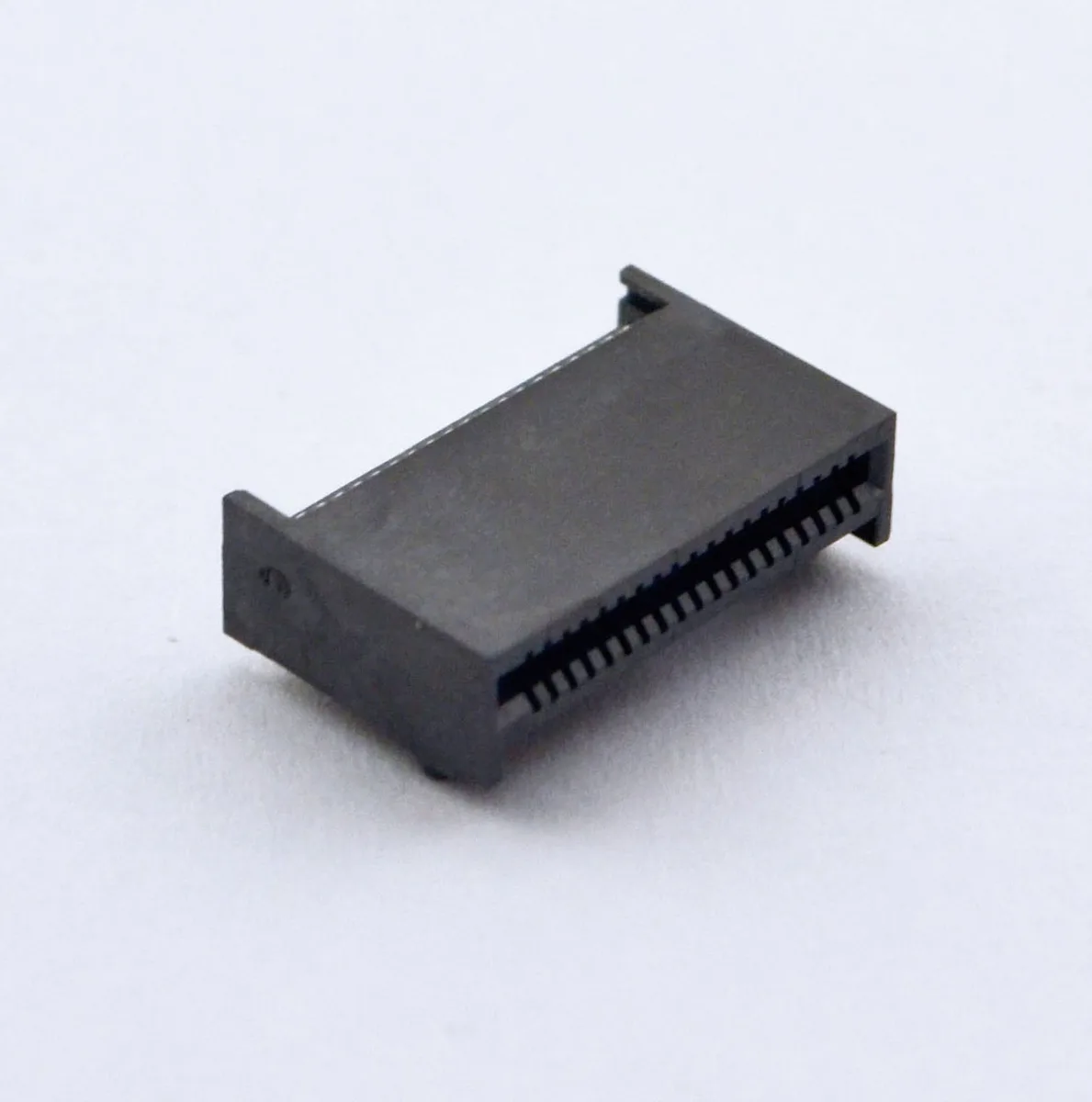
- SFP/SFP+ cage assemblies with integrated EMI shielding and light pipes, designed for switch and NIC manufacturers.
All CZT data center connectors are manufactured to TIA, IEC, and Telcordia GR-326 standards and are backed by full test data and traceability documentation. Learn more about our data center fiber solutions in our Tier-3 data center deployment case study.
Data Center Cabling FAQ
Is fiber optic cable better than copper for data centers?
Not across every use case. Fiber is usually better for longer reach, higher bandwidth, and denser future upgrades, while copper remains attractive for short-reach links and any application that needs PoE. In real facilities, the winning design is often hybrid: copper for server and device adjacency, fiber for aggregation, spine, and backbone links.
What is the maximum distance for copper cabling in a data center?
That depends on the Ethernet standard and cable class. As a practical rule, Cat6a supports 10G up to 100 meters, while Cat8 is commonly used for 25G/40G short-reach links up to about 30 meters. Once distance, speed, or density pushes beyond those limits, fiber usually becomes the cleaner and more scalable design choice.
Why do data centers use multimode fiber instead of single-mode?
Multimode fiber is popular for many in-hall links because it can offer a good balance of high bandwidth and lower optics cost over short to medium distances. Single-mode still wins for long-term backbone flexibility and longer runs. The decision is usually not “multimode or single-mode forever,” but which layer of the data center network each one should serve.
What connectors are used for data center fiber cabling?
For many switch and server optics, LC duplex connectors are still the standard choice. In higher-density architectures and parallel optics deployments, MPO or MTP connectors are common for trunks and breakout designs. Connector selection should match the optics form factor, polarity plan, cleaning workflow, and migration path — not just the immediate transceiver order.
How do I plan structured cabling for a new data center?
Start with the target architecture: speed tiers, rack density, switch topology, growth horizon, and whether PoE is required. Then map run lengths and assign copper or fiber based on distance, bandwidth, density, and upgrade path. Good planning also includes pathway space, cable management, polarity control, and connector standardization so the plant stays maintainable after turn-up.
Related Reading
- Cat8 vs Cat6a for High-Speed Copper Links
- Single-Mode vs Multi-Mode Fiber
- Types of Fiber Optic Connectors
Talk to CZT About Data Center Cabling Components
Whether you are deploying a new data center or upgrading an existing facility, the right connectors are the foundation of reliable, high-performance structured cabling. CZT supplies precision-manufactured fiber optic and copper connectors to data center operators, system integrators, and OEMs worldwide.
Explore our fiber optic connector catalog and RJ45 connector range, or contact our engineering team to discuss your data center cabling project. We provide technical consultation, samples for qualification, and volume pricing for projects of any scale.


