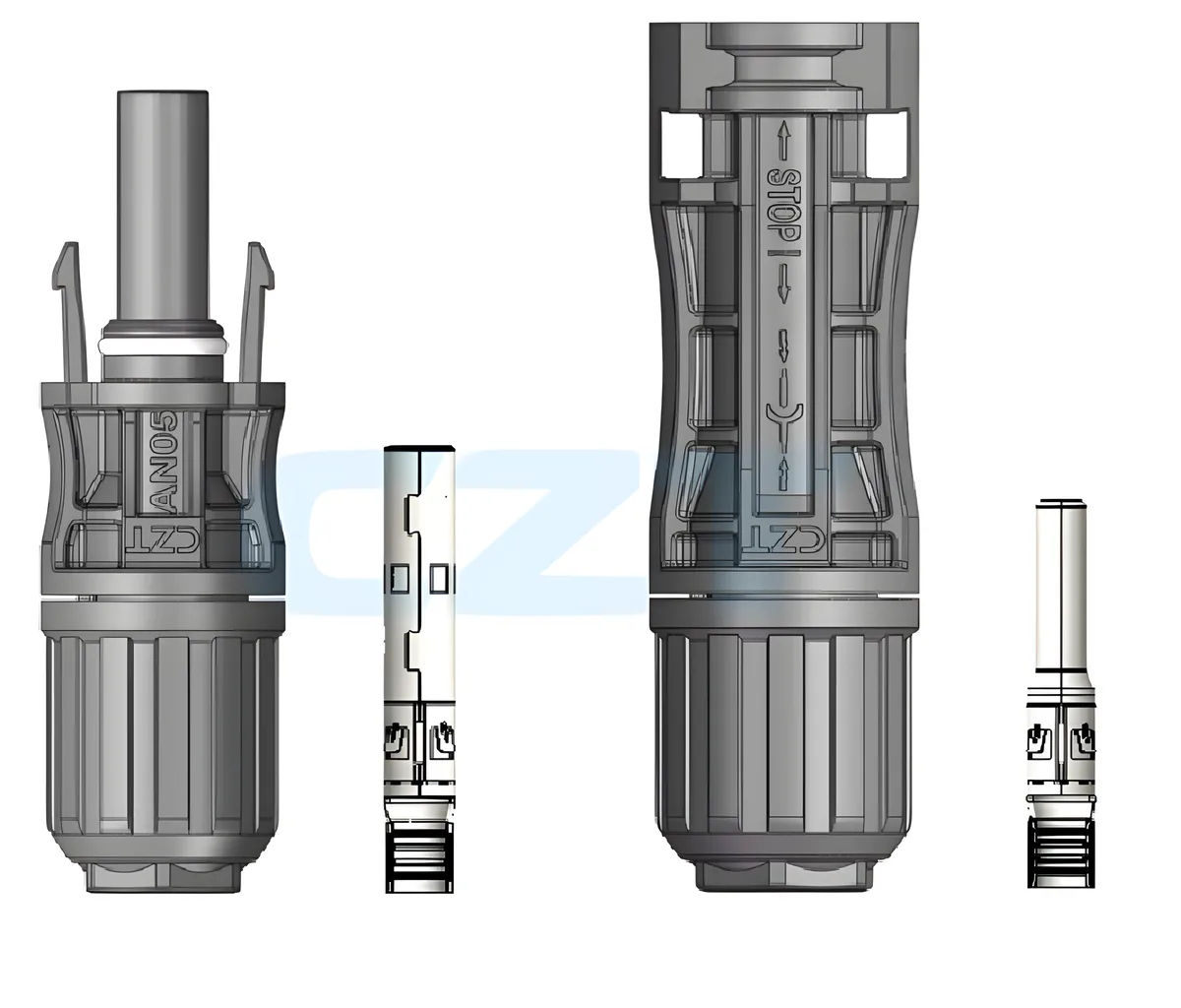
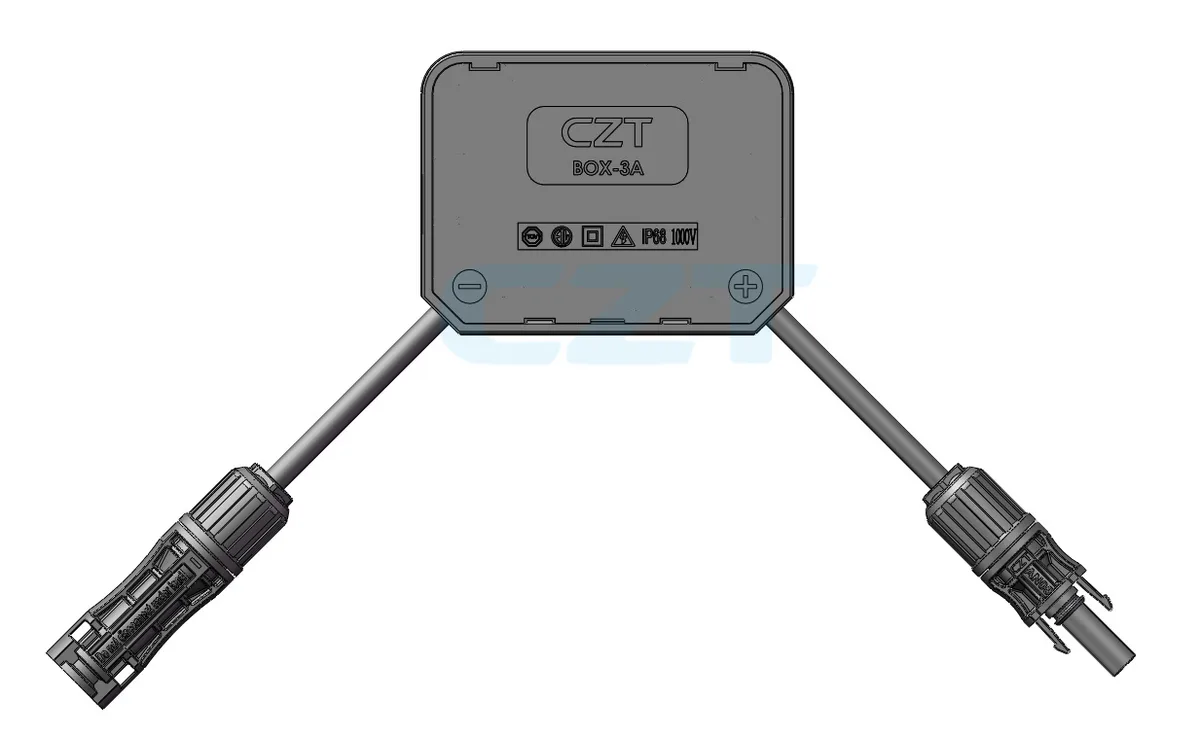
Walk through any solar trade show and you will see dozens of connectors that look identical to the original MC4. Same shape. Same snap-lock mechanism. Same 4 mm contact pin. But are they really the same?
The short answer is no. The longer answer matters a great deal if you care about system reliability, safety certifications, and the 25-year performance warranty on your solar installation.
The term MC4 compatible has become one of the most misunderstood phrases in the solar industry. Some compatible connectors are engineered to the same standards as the original and perform flawlessly for decades. Others cut corners on materials, tolerances, and testing, creating hidden risks that may not surface until years into a system's life.
In this article, we break down exactly what separates genuine MC4 connectors from MC4-compatible alternatives, when compatibility is acceptable, when it is not, and how to verify that any connector you source will hold up in the field.
If you are new to MC4 connectors entirely, start with our complete MC4 connector guide for a full technical overview.
What Makes a Connector "MC4"?
The name MC4 stands for Multi-Contact 4 mm, referring to the 4 mm diameter contact pin at the heart of the connector. It was developed by Multi-Contact, a Swiss electrical connector company founded in 1962. Multi-Contact was acquired by Staubli International in 2002, and the product line is now sold under the Staubli Electrical Connectors brand.
Here is the critical point: MC4 is a registered trademark owned by Staubli. Only connectors manufactured by Staubli can legally be called "MC4 connectors." Every other manufacturer producing connectors with the same form factor must use terms like "MC4-compatible," "MC4-type," or "MC4-equivalent."
This is not just a legal technicality. The original MC4 design is backed by decades of field data, rigorous in-house testing, and continuous refinement. Staubli controls every aspect of manufacturing, from the copper alloy in the contact pins to the polymer blend in the housing.
The original MC4 product line includes several variants:
- MC4 -- the standard connector rated for 1000V DC / 30A
- MC4-EVO2 -- rated for 1500V DC / up to 70A
- MC4-EVO3 -- the latest iteration with improved contact geometry
MC4-Compatible Connectors Explained
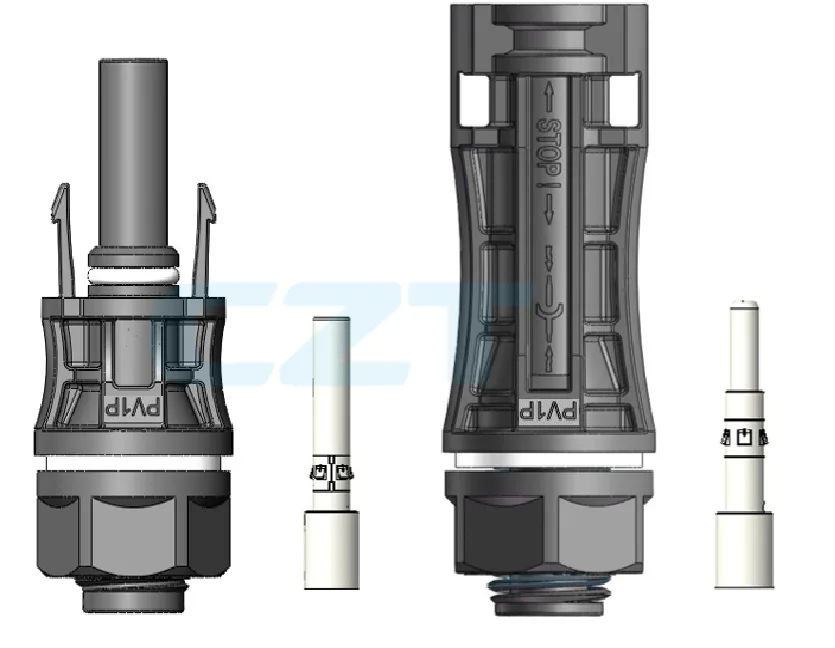
An MC4-compatible connector is any solar PV connector designed to mate with the MC4 form factor but manufactured by a company other than Staubli. There are hundreds of these manufacturers worldwide, with the largest concentration in China, where companies like CZT produce millions of solar connectors annually.
Compatible connectors replicate the MC4's external dimensions, locking mechanism, and 4 mm contact interface. A well-made compatible connector will snap onto a genuine MC4 with the same satisfying click and provide the same IP-rated seal.
But "compatible" is a spectrum. At one end, you have manufacturers who invest in materials science, precision tooling, and third-party certification. At the other end, you have low-cost producers who reverse-engineer the external shape without matching the internal engineering. The key variables include:
- Contact material and plating -- genuine MC4 uses tin-plated or silver-plated copper alloy. Cheap alternatives may use lower-grade copper or thinner plating that degrades over time.
- Housing polymer -- the original uses PPO (polyphenylene oxide) with specific UV stabilizers. Inferior housings may use cheaper plastics that become brittle after years of sun exposure.
- Seal quality -- the O-ring and cable gland seals determine whether the connector maintains its IP68 rating over time. Poor seals lead to moisture ingress and corrosion.
- Dimensional tolerances -- even fractions of a millimeter matter. Loose tolerances cause higher contact resistance and weaker locking force.
- Spring contact design -- the female contact's spring mechanism determines long-term electrical performance. Weak springs lose tension over thermal cycling.
Not all compatible connectors are inferior. Some manufacturers meet or exceed the original specifications. The difference is in the engineering commitment and quality control behind the product.
For a broader look at how to evaluate solar panel connectors, see our dedicated guide.
Key Differences: Genuine MC4 vs MC4-Compatible
The table below compares genuine Staubli MC4 connectors against typical MC4-compatible connectors across the parameters that matter most for long-term system performance.
| Parameter | Genuine MC4 (Staubli) | High-Quality MC4-Compatible | Low-Quality MC4-Compatible |
|---|---|---|---|
| Contact Material | Copper alloy, silver or tin plated | Copper alloy, tin or silver plated | Brass or low-grade copper, thin plating |
| Housing Material | PPO with UV stabilizers (UL 746C f1) | PPO or PA (Nylon) with UV stabilizers | Generic PA or PBT, limited UV resistance |
| Contact Resistance | < 0.5 mOhm | < 0.5 mOhm (certified) | 0.5 - 2.0+ mOhm (often untested) |
| IP Rating (Mated) | IP68 (certified) | IP67 / IP68 (certified) | IP65 claimed (often uncertified) |
| Temperature Range | -40 C to +85 C | -40 C to +85 C | -20 C to +85 C (or untested) |
| Voltage Rating | 1000V / 1500V DC | 1000V / 1500V DC | 1000V DC (may not hold at altitude) |
| TUV Certification | Yes | Yes (reputable brands) | No or expired |
| UL Certification | Yes (UL 6703) | Some manufacturers | Rarely |
| IEC 62852 Compliance | Full | Full (top-tier) | Partial or none |
| Mating Cycles | > 100 (tested) | > 100 (tested by top-tier) | Unknown |
| Warranty | Staubli product warranty | Manufacturer warranty varies | Limited or none |
| Price (Approximate) | $$$ | $$ | $ |
The takeaway: a high-quality MC4-compatible connector from a reputable manufacturer can match the original on every technical parameter. The risk lies in connectors that look identical on the outside but fall short on the inside.
Cross-Mating Risks: The Hidden Danger
Cross-mating refers to connecting an MC4 connector from one manufacturer with an MC4-compatible connector from a different manufacturer. This is one of the most common practices in solar installations, and one of the most debated.
Staubli's official position is clear: they do not recommend cross-mating and will void their product warranty if their connectors are mated with third-party products. Most reputable compatible connector manufacturers take a similar stance, recommending that both the male and female sides come from the same manufacturer.
Why does cross-mating matter? Because even small dimensional differences between manufacturers can cause real problems.
Contact Resistance
The 4 mm pin-and-socket interface relies on precise spring tension to maintain low contact resistance. If the pin from Manufacturer A is at the upper tolerance limit and the socket from Manufacturer B is also at the upper limit, the fit may be too tight, damaging the spring contact. If both are at the lower end, the fit is too loose, increasing resistance.
Higher contact resistance means more heat at the connection point. Over thousands of thermal cycles, this accelerates degradation. In extreme cases, it leads to thermal runaway -- a fire risk.
Water Ingress
The IP68 seal between mated connectors depends on the precise alignment of O-rings and housing surfaces. Cross-mated connectors may not seal as tightly, allowing moisture to penetrate over time. In humid or coastal environments, this leads to corrosion of the contact surfaces, further increasing resistance.
Locking Mechanism Reliability
The snap-lock must provide enough retention force to prevent disconnection from cable weight, wind vibration, or thermal expansion. Mismatched geometries can result in connectors that feel secure during installation but work loose over years of mechanical stress.
Warranty Implications
This is the practical concern that matters most to system owners and EPC contractors. Cross-mating voids the connector manufacturer's warranty. If a connector failure causes a system fire or production loss, the liability question becomes complicated when two different manufacturers are involved and neither will accept responsibility.

When MC4-Compatible Is Acceptable
Despite the risks of cross-mating, MC4-compatible connectors are used in the vast majority of solar installations worldwide. The economics are straightforward: genuine Staubli MC4 connectors carry a significant price premium, and on a utility-scale project with tens of thousands of connections, the cost difference is substantial.
Here is when using MC4-compatible connectors makes good engineering and business sense:
Use MC4-compatible connectors when:
- The connectors carry TUV certification to IEC 62852 and have been independently tested
- Both male and female connectors come from the same manufacturer (no cross-mating)
- The manufacturer provides documented contact resistance, IP rating, and thermal cycling test data
- The manufacturer has a track record in the solar industry with verifiable field installations
- Your project specifications and local codes permit compatible connectors
- The connectors are assembled using the manufacturer's specified crimping tools and procedures
Use genuine MC4 connectors when:
- The project specification explicitly requires Staubli MC4 (common in some European utility tenders)
- You are connecting to equipment that ships with pre-installed genuine MC4 pigtails and the equipment warranty requires same-brand mating
- The installation is in an extreme environment (high altitude, coastal, desert) where you want the maximum margin of safety
- Regulatory or insurance requirements mandate original-brand connectors
The key principle is simple: never cross-mate, and always verify certification. A certified MC4-compatible connector from a single manufacturer is a sound engineering choice. A mix of uncertified connectors from multiple sources is a liability.
How to Verify Connector Quality
Not all certifications are equal, and not all claims on a datasheet are accurate. Here is how to verify that an MC4-compatible connector actually meets the standards it claims.
Check TUV Certification
TUV (Technischer Uberwachungsverein) is the gold standard for solar connector certification. A TUV-certified connector has been independently tested for electrical performance, mechanical durability, environmental resistance, and fire safety.
You can verify a connector's TUV certification by searching the TUV Rheinland or TUV SUD online certificate databases. If a manufacturer claims TUV certification but cannot provide a certificate number, treat the claim with skepticism.
Verify IEC 62852 Compliance
IEC 62852 is the international standard for "Connectors for DC application in photovoltaic systems." It defines the test methods and performance requirements that any solar DC connector must meet. A connector that is "designed to IEC 62852" is not the same as one that is "tested and certified to IEC 62852." Look for the actual test report.
Request Test Reports
A reputable manufacturer will provide contact resistance measurements (initial and after thermal cycling), IP rating test reports from an accredited lab, temperature rise test data at rated current, and UV aging and salt mist corrosion test results.
Inspect Physical Quality
Even without lab equipment, you can assess connector quality through visual and tactile inspection. The contact pin surface should be smooth and uniformly plated with no visible base metal. The housing finish should be uniform with no flash, sink marks, or rough parting lines. Seals should sit properly in their grooves, and the locking mechanism should engage with a firm, positive click.
For a deeper dive into what certifications mean for connector procurement, read our connector certifications guide.
CZT's Approach to Solar Connector Quality
At CZT (Shenzhen Chuangzhitong Electronics, SZSE: 002897), we manufacture MC4-compatible solar connectors that are engineered to meet or exceed the performance of the original MC4 design. Our approach is built on three pillars.
Materials That Match the Original
Our solar connector contacts use high-conductivity copper alloy with silver or tin plating applied to controlled thickness specifications. Our housings are molded from PPO with UV stabilizers rated to UL 746C f1, the same material class used in the genuine MC4. We do not substitute cheaper polymers to save cost.
Independent Certification
Every CZT solar connector product is submitted for independent TUV certification to IEC 62852. We publish our certificate numbers and make test reports available to customers on request. We also hold UL certifications for products sold into the North American market. Our full certification portfolio is detailed on our renewable energy solutions page.
Designed as a System
We manufacture both male and female connectors, branch connectors, panel-mount connectors, and extension cables as a complete system. Every component is designed and tested to mate with other CZT components. We do not recommend cross-mating our connectors with other brands, and we provide full technical support to ensure our connectors are assembled and installed correctly.
Our solar PV connector product line includes standard and high-current variants rated for 1000V and 1500V DC systems, covering the full range of residential, commercial, and utility-scale applications.

Frequently Asked Questions
Can I connect an MC4-compatible connector to a genuine MC4?
Technically, most MC4-compatible connectors will physically mate with a genuine Staubli MC4. However, this is cross-mating, and neither manufacturer will warranty the connection. If you must cross-mate, verify that both connectors are certified to IEC 62852 and perform a contact resistance test after assembly. The safer approach is to use connectors from a single manufacturer for both sides.
Are MC4-compatible connectors legal to use in solar installations?
Yes. No law or building code requires genuine Staubli MC4 connectors. Codes require that connectors meet applicable safety standards (such as IEC 62852 or UL 6703) and are installed per manufacturer instructions. A TUV-certified MC4-compatible connector meets these requirements. Some project specifications or equipment warranties may require specific brands, so always check your project documents.
How can I tell if an MC4-compatible connector is good quality?
Look for three things: independent TUV or UL certification with a verifiable certificate number, published test data for contact resistance and IP rating, and a manufacturer with a proven track record. Physical inspection also helps -- high-quality connectors have smooth, uniformly plated contacts, well-molded housings, and properly seated seals.
What happens if I cross-mate connectors from different manufacturers?
Cross-mating introduces risk because dimensional tolerances vary between manufacturers. Common issues include increased contact resistance (leading to heat buildup), compromised IP sealing (leading to corrosion), and weakened locking force. These problems may not appear immediately but develop over years of thermal cycling. Cross-mating also voids the warranty from both manufacturers.
Why are genuine MC4 connectors more expensive than compatible alternatives?
Staubli's pricing reflects their R&D investment, Swiss manufacturing costs, and global quality control infrastructure. MC4-compatible connectors from manufacturers in China benefit from lower labor and overhead costs. However, price alone does not determine quality. A well-engineered compatible connector from a certified manufacturer like CZT delivers equivalent performance at a lower price point, while a cheap uncertified connector may cost far more in the long run through failures and warranty claims.
Choose the Right Solar Connector for Your Project
The MC4 vs MC4-compatible debate is not about brand loyalty. It is about engineering rigor. Whether you choose genuine or compatible, the principles are the same: verify certification, never cross-mate, and demand test data.
If you are sourcing MC4-compatible solar connectors for your next project, we invite you to evaluate CZT's product line. Our connectors are TUV-certified, independently tested, and backed by the engineering resources of a publicly listed connector manufacturer.
Explore our solar PV connector products to review specifications and certifications.
Contact our engineering team to discuss your project requirements, request samples, or obtain test reports.